Nukes Over the Pacific – A Look Back Sixty Years Later
J.B. Rivard
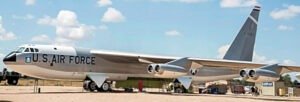
Boeing B-52B, 52-0013, used to perform the nuclear airdrops during Operation DOMINIC. This aircraft is on display at the Heritage Park at the National Museum of Nuclear Science and History in Albuquerque, New Mexico. (USAF photo)
Nukes Over the Pacific – A Look Back Sixty Years Later; a crew member recalls the mushroom clouds
The period between the Korean War (1950-1953) and the Cuban Missile Crisis (1962) was the height of the Cold War, so named because the conflict between the United States and the Soviet Union was “cold” — large-scale fighting between the adversaries did not occur.
In late 1958, the United States, Great Britain and the Soviet Union tacitly agreed to a moratorium on nuclear testing. In 1961, newly-inaugurated President John F. Kennedy wished to extend the moratorium, but the Soviet Union rejected proposals for a formal ban on atmospheric tests.
On Aug. 30 of 1961, the Soviets announced they would resume nuclear testing. Two days later, they detonated a 50 megaton nuclear device. Kennedy responded by authorizing Operation DOMINIC, the largest nuclear testing program conducted by the United States and the last in earth’s atmosphere.
The world was forever changed July 16, 1945, when a sudden, brilliant explosion lit an isolated valley in New Mexico. The bright flash was seen by watchers at Los Alamos, 200 miles away. That nuclear detonation, code named “Trinity,” had the energy equivalent of about 22,000 tons (22 kt) of TNT, which changed the nature of war.
In March of 1962 — less than 17 years later — I boarded a USAF C-130 at Hickam Air Force Base in Hawaii. As a young engineer on the staff of Sandia Corporation, I was scheduled to participate in what was called Operation DOMINIC, a complex series of nuclear detonations over the Pacific Ocean, was ordered by President John Kennedy in 1961 as a response to the Soviet Union’s breaking of a test-ban agreement (see “Cold War” sidebar).
Four hours later, I landed near the equator on the coral atoll now called Kiritimati.
THE ISLAND
The island was known as Christmas Island in 1962. It gained the latter name from having been discovered Christmas of 1777 by Captain James Cook.
The name Kiritimati is pronounced as “Ki-ris-mas,” because in the Gilbert Island language, “ti” is pronounced as “s.” The renaming occurred in 1979 when Christmas and 32 other remote Pacific islands became independent of the United Kingdom as the nation of Kiribati.
The government of Kiribati claims Kiritimati is the largest (area) coral atoll in the world with an area of at least 140 sq. miles. The Y-shaped island features a large bay, open to the ocean, on its northwest side. Numerous saltwater (tidal), mixed, and rainwater basins fill the interior. Geometrically, the island roughly fits inside a rectangle 30 miles long by 14 miles wide (420 square miles). Because of its shape and interior water-filled areas, the area of dry land is only about the size of Barbados.
The land is bare coral sand with low shrubs and large patches of coconut palm trees. Between the World Wars, 300,000 of the palms were planted by French priest Emmanuel Rougier, who leased the island until his death in 1932. These grew to 800,000 trees in the late 1930s. Island residents continue to market the dried kernel of coconut (copra), which is a source of food, cooking oil, and livestock feed.
The ocean waves offshore of the island, having traveled unimpeded for thousands of miles, become very powerful. Thus, the coral reef surrounding the island featured large breakers, waves that crested steeply a distance from shore and crashed into the shallows with dramatic flair. Dozens of dolphins or porpoises were sometimes visible swimming parallel to these cresting waves.
One of Kiritimati’s peculiarities came quickly to my attention — thousands of pink land crabs that crawled everywhere on the land. Their omnipresence became obvious as “snaps” were heard regularly while driving a paved section of road — the sound of crabs being crushed under the wheels. These ferocious-appearing, stalk-eyed creatures waving two big claws were not even slightly ferocious, despite their appearance. They moved only slowly, and were either unafraid of humans . . .
This article costs $5.00 to download - or it's free for AAHS members.
Already a member? Sign in to download for free.