
Northrop Gamma 2B, A Northrop to Conquer the South Pole
Alain Pelletier
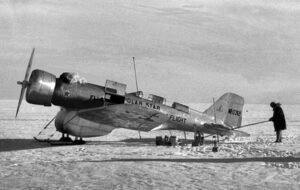
The Polar Star is prepared for a flight on one of the few days of good weather. The front cargo hold, open, is clearly visible here. [McDonnell Douglas photo from Harry Gann collection]
Northrop Gamma 2B, A Northrop to conquer the South Pole
By the dawn of the 1930s, the most prominent aerial explorers such as the Roald Amundsen, Hubert Wilkins, Richard Byrd or Lincoln Ellsworth, had flown over most of the polar regions, and very few areas were still untouched by any human footprint. Representing over 3 million square miles, these unexplored regions were all located in Antarctica, in particularly inhospitable regions. For this handful of adventurers a new exploration mission would most certainly be the last.
In 1930, Richard Byrd, whose recent exploits had resulted in displays of enthusiasm, some of which had confined themselves to delirium, had only one idea in mind, that of returning as soon as possible to Little America, his polar base where he had left two planes1 for reuse in a new expedition. But he still needed to raise at least a million dollars for this! In this period of economic crisis, this seemed almost impossible. For the time being, Byrd abandoned any desire to make a trans-Antarctic flight. In late 1931 he wrote to Lincoln Ellsworth offering his support. “My dear Lincoln,” he wrote to him, “a number of sources suggest to me that you are planning to mount an expedition to the South. I would like to talk about it with you so that I can provide all the help you will need.”2
The object of Ellsworth’s thoughts was, one guesses, a flyby of Antarctica, and to do so he needed a plane, a pilot and a boat. On April 18, 1932, on letterhead of the Ellsworth Trans-Antarctic Flight, he entrusted the Norwegian pilot Bernt Balchen with the responsibility of choosing an aircraft and the radio equipment necessary for his expedition. He also left it to Balchen to draft the contracts for the acquisition of these materials. On the same day, the project was presented in the Herald Tribune.
In the early spring of 1932 Ellsworth and his team set to work. Initially a contract was signed with Northrop Corp. for the design and delivery of an all-metal aircraft for $37,000, 50% of which was paid immediately. Ellsworth appointed Bernt Balchen to act as a “go-between” between himself and the design office. Finally, he asked his old friend, Hubert Wilkins, to look for a suitable boat and to settle various small administrative hassles.
By early 1933, the expedition’s organization had progressed well, as had the construction of the aircraft, which Balchen described as an entirely new model and design. As such, this aircraft would require numerous flight tests. It was indeed the second Northrop Gamma (Gamma 2B) and it differed significantly from Gamma 2A in several points . . .
This article costs $5.00 to download - or it's free for AAHS members.
Already a member? Sign in to download for free.