
Naval Air Station‘s next Mission after National Defense
Diane S. Segal
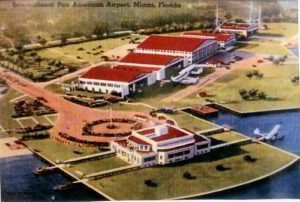
1934-era Pan American postcard showing terminal building and hangars at Dinner Key. (Photo from the History Miami Museum collection)
Naval Air Station’s next Mission after National Defense
Dedicated in loving memory to my mother, Dorothy M. Segal, for her service to the Navy Department, Bureau of Aeronautics, Naval Air Experimental Engineering Command, in Philadelphia, Penn., as a civilian during WWII. Her work involved assisting in the preparation of confidential reports on radar, Loran and sonar.
Base closures and realignments increase efficiency.[1] 10-USC-2687 mandates evaluations of strategic and operational consequences,[2] costs, savings and redevelopment.[3] A commission provides recommendations to the President who prepares a report.[4]
Extraordinary events took place at two long-closed Navy bases that were actively used in defense of country " Dinner Key, Florida, and Glynco, Georgia.
BEGINNING OF NAVAL AVIATION IN FLORIDA
In December 1911, Glenn Curtiss, the aviation pioneer, started Miami’s first flight-training school. It lasted only one season. But in December 1916, Curtiss Flying School opened on Miami Beach.[5]
Curtiss became one of the state’s first real estate developers.[6] (His Miami Springs 1925 pueblo-style mansion is being restored.)[7]
NAVY PLANS FOR THE FUTURE
The Navy Board of Aeronautics chose Pensacola as the primary location for Naval Aviation in 1914. Then the Naval Aircraft Factory was established in 1917. WWI commenced and the United States declared war against Germany on April 6, 1917. Consequently, additional air stations were needed. One was established at Dinner Key in Coconut Grove, Florida. It was designated as an elementary flight and patrol station. Seaplanes were used.[8]
COCONUT GROVE
Coconut Grove is located in the southeast region of Florida about five miles below Miami on Biscayne Bay. Coconut Grove had an interesting beginning. Pursuant to the 1862 Homestead Act, Edmund Beasley, in 1868, filed for the first homestead in Coconut Grove. He died before he could prove it and his widow, Anna, rented the homestead to Dr. Horace Porter who claimed it for himself. Anna prevailed at the land office and Porter left. Porter had opened the "Cocoanut Grove"Â Post Office in 1873 and gave the community its name.
Before the City of Miami was born in 1896, Coconut Grove was the largest and most influential community in the area.
In October 1917, the Navy began construction of the air station at Dinner Key.[9]
NAS DINNER KEY
Dinner Key has been described as a little island a few inches above water, with mangrove trees and coconut palms. Boats going to Homestead from Miami stopped there for midday meals. It became known as Dinner Key.[10]
The Navy sent Lt. P. Bellinger to investigate Miami’s possibilities for a naval aviation station.[11]
The station was to be a post-graduate school for aviators who had previous training elsewhere. Upon completion of the course, they would leave for the European fighting fronts.[12]
F.R. Harris, Chief of the Bureau of Yards and Docks, opened bids for filling and dredging.[13] The purpose of the Bureau was to build air bases and provide facilities for ground and flight crews.[14]
Lt. Cmdr. A.C. Read commanded the air station.[15]
During construction, the base had to be filled to raise the land two feet above high tide. Dinner Key became permanently  . . .
This article costs $5.00 to download - or it's free for AAHS members.
Already a member? Sign in to download for free.