
Marston Mat: Secret Weapon of American Air Power
Dr. Richard K. Smith
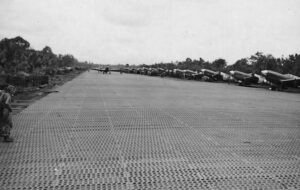
This seemingly simple piece of pierced steel plank material allowed the U.S. to rapidly project airpowe in every theater of operations during WWII. Here we see a fighter strip that was laid out on an old Japanese field at Karako, Aitape, Dutch New Guinea. (USAF photo from National Archives and Records Administration (NARA))
Marston Mat: Secret Weapon of American Air Power
It was 10 feet long, 15 inches wide, covering 12.5 square feet with a surface of Swiss cheese stamped out of steel and it weighed 66.2 pounds. Locked together, 60,000 of them – 1986 tons of stee1 – created a durable all-weather surface 5,000 feet long and 150 feet wide that routinely accepted punishment from 60,000 pound airplanes thumping down upon it at speeds of 90 mph. This is the material that provided the quickly built platforms from which American combat aviation was projected around the world during WWII.
During 1941-45 the material was generally known as "Marston mat." This led many persons to believe that it was invented by someone named Marston. Those endowed with greater imagination suspected that it was a British invention, probably manufactured near Marston Moor, England. The truth is more prosaic. The name is owed to a tiny whistle-stop community on the Seaboard Railway in a the northwest corner of North Carolina’s piedmont 35 miles west of Fort Bragg, (Renamed Fort Liberty in 2023).
It was here on a low hill one mile east of Highway U.S. 1 and two miles northeast of Marston, N.C., that the material was first put to practical use. This was during the Army’s Carolina Maneuvers of November 1941. It was an emminently satisfactory installation that had epochal consequences.
The "Marston strip," 150 x 3,000 feet, was operational for only a few weeks. When the maneuvers ended the runway was dismantled, reloaded into 18 railroad gondola cars and hauled away to Langley Field, Virginia – taking with it the name of Marston. From this small beginning the "Marston strip" as
it – was called entered the Army’s vernacular and the material became known as "Marston mat."
Years later, when memories of WWII had faded and acronyms took absolute control of military vocabularies, the village of Marston lost its claim to fame when grim, soulless bureaucrats gradually reduced the material’s identification to a sterile "PSP" – pierced stee1 plank. A quarter of a century after 1945, the generation that laid hundreds of thousands of tons of Marston mat throughout Southeast Asia had no idea of who or what at Marston might have been: the material was simply "PSP."
Anglo-French Inspiration
In the spring of 1939 the U.S. Army Air Corps took note of operations in Britain and France, where the respective air forces were experimenting with steel grids for unimproved . . .
This article costs $5.00 to download - or it's free for AAHS members.
Already a member? Sign in to download for free.