Just Follow the Rope; WWII Glider Pilots Remember
Scott M. Fisher
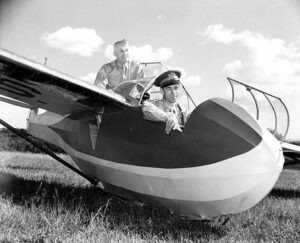
Two of the most influential men in developing the U.S. Army’s combat glider capability was General Hap Arnold (left rear) and Major (later Colonel) Fred Dent, Jr. (seated front), in a TG-2 training glider during September 1941. (National Soaring Museum)
Just Follow the Rope; WWII Glider Pilots Remember
They were some of the most heroic pilots of WWII. They were quick-thinking pilots in command while flying their troops or supplies into battle. Then, if they survived a crash landing, they were transformed into airborne infantry soldiers. They flew on the darkest nights over oceans, mountains and deserts and landed in swamps and jungles and on city streets – sometimes through the deadly gunfire of their own forces. Many died, but thanks to the glider pilots of WWII, thousands of other lives were saved and battles won. The veteran war correspondent, and later television news anchorman, Walter Cronkite, who flew into Holland in a Waco CG-4A glider to report on the ill-fated Market Garden campaign said, "I don’t recommend gliders as a way to go to war. If you have to go, march, swim, crawl – anything, but don’t go by glider!"
At the beginning of WWII, the U.S. military didn’t have any gliders. After the attack on Pearl Harbor, however,
Maj. Gen. Henry "Hap" Arnold was briefed on the success of Nazi glider troops’ invasion of Fortress Eban-Emael and the island of Crete. Arnold declared, "We shall have a glider force second to none in the world." So the scramble began to set up training centers, procure both glider and tow aircraft, find qualified instructors and attract recruits.
Maj. Lewin B. Barringer, a glider pilot in civilian life, was appointed by the Army Air Corps to run the show. He contacted manufacturing companies and private flight schools and sent dozens of recruiters from state to state to line up instructors who had glider experience.
One of those recruiters happened to drive through Plymouth, Mich., and stopped at Triangle Field, where Lyle A. Maxey, Paul "Ed" Laine and Chuck Kohls were members of the Detroit Glider Council. They all agreed to become glider instructors for the U.S. Military, so in January 1942, the three young men headed by car to the Twenty-nine Palms Air Academy in the California desert. Maxey recalls, "We drove continuously and made the trip in about three days. The Air Academy was in a startup mode when we arrived, and we had to go through ground and flight checks to get commercial glider pilot licenses so we could act as paid instructors."
Ed Reeder, another instructor at 29 Palms, explains there were four basic types of student: "Most students came from the Civilian Pilot Training Program (CPTP) as members of the Enlisted Reserve Corps. Others were transfers from the Aviation Cadet program where they’d had sixty hours of flight and ground school, similar to CPT. Some also came directly from the military ranks, and the smallest group were CAA private pilots."
Lyle Maxey adds, "The first six classes of students were commissioned officers who had already completed powered, fixed-wing flight training – regular Army Air Corps pilots, probably about 50 or 60 who would form a cadre of operational flying groups of deployed glider units."
Some of the glider units contained celebrities. Flight Officer John L. "Jackie" Coogan, the childhood film star, was one of Maxey’s students at 29 Palms. "On night operations, on our dry lakebed he [Coogan] would tell dirty stories for two hours every night for about a month and never repeat himself," Maxey recalls. Coogan later served with distinction in the China Burma . . .
This article costs $5.00 to download - or it's free for AAHS members.
Already a member? Sign in to download for free.