James J. "Crash" Ryan; Father of the Black Box
Scott M. Fisher
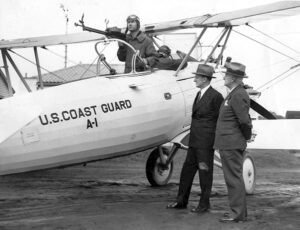
The first of a fleet of biplanes (Vought O2Us) which the Coast Guard will use in border patrol work is shown being inspected at Washington by Secretary of the Treasury Henry Morgenthau, Jr. (left) and RAdm. Harry G. Hamlet, Coast Guard commandant. The planes are equipped with two-way radios, blind flying instruments, and machine guns, which one of the two pilots is shown demonstrating. (U.S. Coast Guard photo)
The Coast Guard Fifteen Plane Mystery
I love a mystery. So, when I stumbled upon a mystery while researching a book about Coast Guard aircraft crashes, it was too hard for me to resist.
The first Coast Guard aviator to die in a Coast Guard aircraft crash was Charles T. Thrun, Coast Guard aviator number 3 and the Coast Guard’s first enlisted aviator. On January 19, 1935, he was killed in the waters off Base Nine Aviation Station (in Cape May, N.J.) in a recently arrived Grumman J2F Duck number No.162.
This event is well-known in Coast Guard aviation history, and since he was the first to die, that would be where my book would start. Or so I thought.
Soon, I discovered that there had been a fatal crash some eight months earlier, one that had been overlooked by the Coast Guard historians. Thus began the unraveling of a mystery.
Smuggling Along the Borders
It might seem surprising to find the Coast Guard—let alone a Coast Guard air detachment—in San Antonio, Texas, far from the nearest coastline. However, a unique series of events led to the creation of a Coast Guard Air Detachment there, supporting U.S. Customs and Border Patrol efforts to combat smuggling along the border.
During Prohibition, smuggling reached unprecedented levels. While the Coast Guard focused on patrolling the coastlines, Customs and Border Patrol agents struggled to monitor the expansive borders. It quickly became apparent that airplanes were the most effective way to cover vast stretches of land. However, while the Coast Guard had aircraft, the Border Patrol lacked both planes and the funds to operate them. Fortunately, the smugglers themselves provided a solution. Customs officials began seizing aircraft from smugglers and repurposing them for their own makeshift "Air Force. " Although there was no funding for these operations, and Washington officially discouraged their use, the men on the front lines found the planes to be the right tool at the right time. In Texas, with assistance from the U.S. Army at Dodd Field, Fort Sam Houston, near San Antonio, a collection of ragtag aircraft was kept in the air using outdated parts and whatever materials were available. Eventually, they were assigned an old hangar on the field.
That these planes were even operational was a minor miracle. Yet, despite the odds, they proved highly effective in curbing smuggling activities. Their success became too apparent to ignore. But the real question was: what could Washington do about it?
Coast Guard Assumes Control
After months of inter-agency negotiations, Secretary of the Treasury Henry Morgenthau intervened in 1934 with a solution. He directed that all aviation activities within the department be consolidated under one organization that already had trained pilots and aircraft: the Coast Guard.
As a result, on March 9, 1934, the U.S. Customs’ air operations were officially transferred to the Coast Guard. Air detachments were established in Buffalo, New York; San Diego, California; and San Antonio, Texas, to assist the Customs and Border Patrol in their efforts.
Although the order provided no additional funding, the Coast Guard formally acquired 15 aircraft from Customs, at least on paper.
Coast Guard personnel arrived at Dodd Field that spring to take over air patrol duties. A small team of five men, led by Lieutenant Clarence (Larry) F. Edge, was tasked with monitoring nearly 2,000 miles of border between Mexico and the U.S. borders of Texas, New Mexico, and Arizona.
First Deadly Crash
A bit before 11 a.m. on the morning of May 29, 1934, one of the former Customs planes, a Curtiss Falcon Mailplane, was readied for a transport flight. Lt. Edge was flying Harry L. Sexton, the U.S. Collector of Customs for San Antonio, home from a meeting in El Paso.
The plane took from the dirt runway of Briggs Field, Fort Bliss, El Paso; however, shortly after takeoff, Lt. Edge noticed . . .
This article costs $5.00 to download - or it's free for AAHS members.
Already a member? Sign in to download for free.