
Jack Randolph Cramm
Cal Taylor
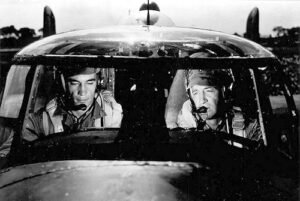
Lt.Col. Jack Cram and copilot 2nd Lt. Robert L. Paveligo preflight a PBJ in early 1945 for a mission against Japanese shipping north of Iwo Jima. (USMC photo from the author’s collection)
Introduction
Jack Randolph Cram was hired in 1935 by the city of Olympia, Wash., to be the first manager of the 24-yearold Olympia Airport. He was already the first Washington State pilot, working for the Highway Department. Aviation activities on the field began with the first air show in 1911 on the Bush Prairie Airfield Site, south of neighboring Tumwater, Washington. In 1928, the Aviation Committee of the Olympia Chamber of Commerce spent $35,000 to buy 196 acres. Over time, the airport grew to three turf runways, typical of airports of the day. More land was purchased in 1929. With a manager in place, major improvements were made. In time, Cram went on to work with the federal Civil Aeronautics Administration before going on active duty in 1941. He became a heroic USMC aviator in the Pacific Theater. Later, he commanded Marine units in the Pacific and during the Korean War, eventually retiring as a brigadier general. Subsequent to retirement, Cram served as president of an aviation industry association.
Background
Jack Cram was born in Berkeley, Calif., on February 25, 1906. He had three older sisters and a younger brother. The family later moved to Washington state, where Cram attended the University of Washington. There, he made a name for himself as a football player and track star. He graduated from the university in 1929.
In 1930, Cram enlisted in the USMC Reserve, which sent him to flight training at Naval Air Station (NAS) Sand Point, in Seattle, Wash., and NAS Pensacola, Florida. During the next three years, he became friends with fellow pilot Gwin Hicks, who was working for the Washington State Highway Department. That connection resulted in Jack Cram’s hiring in 1933 as the first state pilot for Washington, along with Byron Cooper, a lieutenant in the U.S. Army Reserve.
Even as he was flying for the Washington State Highway Department, Cram was adding flying time to his logbook as a Marine Reserve pilot. In July 1934, then-Second Lt. Jack R. Cram was one of the six pilots that flew a formation of six Curtiss SBC Helldivers from Seattle to Montana. They were assigned to Observation Squadron 8 (VMO-8), probably based at NAS Sand Point. The purpose of the flight was to fulfill training requirements, though a public affairs component was part of the mission. The aircraft made demonstration and photo flights in Butte and Helena, Montana.1 The training for these aircraft fulfilled the early stages of the skills that Jack Cram demonstrated in WWII and the Korean War. Another connection to his wartime career was Capt. Lofton Henderson, who was promoted to captain while assigned to Observation Squadron 8. Henderson was killed in the early days of the 1942 . . .
This article costs $5.00 to download - or it's free for AAHS members.
Already a member? Sign in to download for free.