Instrument Flying and Radio Navigation, the Early Years
Richard C. Hill
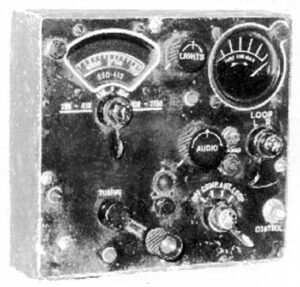
Pilot’s Radio Control Panel for the ARN-7, World War II to the mid-1960’s. Frequency selections were made from three bands, 200 to 410, 410 to 850 and 850 to 1750 Kilocycles. The selection in the picture is the middle band and at 760 KC. (Photo from Richard C. Hill Collection).
Instrument
Flying and Radio Navigation, The Early Days
Starting when I was
sixteen, aviation has been my life. It really began before that, I was
hooked when I read the letters my older brother sent to my father during
his World War II Air Corps training.
September 1944, the local airport was
reopened. All of the "unnecessary" airports were closed during
the war for fear, real or imagined, that the Japanese would steal a plane
and bomb some military establishment.
A Cub flew over the car while I was
driving home from school one evening and I followed it to the airport.
There was a sign on the office door that read "PLANE RIDES
$2.00." I had been saving a two dollar bill for just such an
occasion. At the end of my ride, the instructor, Clarence Gallagher, of
Antioc, Illinois, said, "If you decide to take flying lessons, this
flight will go into your logbook as your first lesson." Swish, the
arrow hit me right in the heart and it is still there, fifty six years
later. I’m pleased it carried an incurable disease. I quit high school in
my junior year, not being a good student, I spent the remainder of the
year working for Wayne Carpenter at his airport in Waukegan, Illinois.
Wayne, now 90 years old, resides in Ojibwa, Wisconsin.
In the fall of 1945,1 enlisted in the
Marines and after completing boot camp in the spring of 1946, was
transferred to the Naval Air Station at Atlanta, Georgia. There I was
enrolled in classes at the Link Instrument Trainer Instructors School.
LITIS was a very concentrated program that provided me with an education
that I feel equal to a commercial license with an instrument rating. It
covered all of the normal ground school subjects, including Navigation,
Meteorology, Civil Air Regulations, Morse Code, ATC procedures and radio
communications. The Instrument flight training, included cross country
navigation flights that were made using instructor simulated ATC
Clearances. (Currently, using advanced simulators, these flights are
called LOFTs, Line Oriented Flight Training.) The courses were on a
parallel with the regular CAA commercial pilot flight training. The main
difference was that all of the flying for the trainee was done in the
NAVBIT-45, Link trainer. In May 1946,1 graduated from that school while my
. . . . .
This article costs $5.00 to download - or it's free for AAHS members.
Already a member? Sign in to download for free.