Immigrants in Aviation – Rotorcraf: Rotor-Revoluntionaries from Abroad
Richard Harris
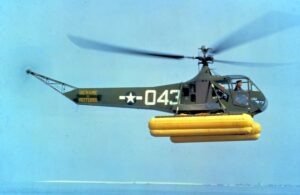
Rare color photograph of a Sikorsky R-4 with floats and a litter. (AAHS photo archives, Gerald Balzer collection)
Immigrants in Aviation – Rotorcraft: Rotor-Revolutionaries from Abroad
Too seldom recognized in American aviation historiography is the enormously formative foreign
influence on the development of American aviation. From the French invention of the balloon, to French/Brazilian dirigibles, to WWI German fighters, to British and Italian seaplane racers, to Spanish autogyros, to the emergence of sweptwing German jets and Soviet spacecraft, foreign developments have driven major American aerospace developments.
But, also, many major "American" aerospace developments have actually been the product of foreign-born immigrants, or their children. From Chicago-Frenchman Octave Chanute’s trend-setting gliders (largely imitated by the Wrights), to German rocket scientist Werner Von Braun’s virtual invention of U.S. spaceflight, America has depended on immigrantingenuity for much of its aerospace progress.
Nowhere in American aviation are the impacts of immigrants and their offspring more obvious than in the world of rotary-winged aircraft. Various nations have lost much of their vertical-flight talent to the U.S. – the former Soviet Union in particular. Many Russians and neighboring ethnics fled the October 1917 revolution, as it turned the brutal Czar’s Russian Empire into a civil-war hell-hole, degenerating into the pseudo-communist Soviet Union police state. Among those fleeing were many of that empire’s educated and scientific elite, including three of the greatest helicopter pioneers in history.[1] Other immigrants beget fellow founders of "American" vertical flight.
DeBOTHEZAT
Among the immigrants was the "Mad Russian" aeronautical engineer Prof. George deBothezat. Arriving in the U.S., he crafted the U.S. Army’s first helicopter – a massive four-rotor contraption that, in the early 1920s, hovered, with very limited control, in ground effect. By April 1923, it lifted the pilot and three passengers 10 feet off the ground in a hover, then 30 feet – not yet useful, but a vertical lift unmatched for the next two decades. The U.S. Army, alas, saw no value in continuing the $200,000 project.[2]
BERLINER
German-Jewish immigrant Emile Berliner, a prolific inventor, was another rotorcraft pioneer. Upon inventing the common, loose-carbon telephone transmitter (microphone), he was hired into the fledgling American Bell Telephone company, engineering there for seven years, helping fellow immigrant Alexander Graham Bell turn the telephone into a practical appliance. Emile then invented the gramophone – forerunner of the phonograph – and the flat recording disk (now known as a “phonograph recordâ€), eclipsing Thomas Edison’s awkward recording cylinders. This facilitated mass production of recordings, creating the recording industry and the corporate beginnings of pioneering audio/radio/TV/avionics colossus RCA. Berliner invented acoustic tiles that transformed concert halls, and even parquet flooring. And a few early helicopters.[3]
With his son Henry, Emile designed and built rudimentary experimental helicopters from 1907-1926. His earliest two helicopters were powered by the world’s first airborne rotary engines, adapted by Emile. Their early helos flew, briefly – including one, flying a minute and a half, up to 100 yards, in 1924. Their 1924 Helicoplane flew sideways 400 yards, up to 40 mph, and 30 feet vertically, above ground effect, under control[4] Their rotor-aircraft – including a triplane with twin main rotors over the wings and a horizontal tail rotor – weren’t particularlycontrollable. But they’d showed that helicopters could truly fly.[5]
In 1920, they established Berliner Aircraft Co. (becoming Berliner-Joyce in 1929).[6] Then, in the early 1930s, son Henry started Engineering Research Co. ("ERCO"), soon famous fortheir pioneering lightplane: "ERCOupe"[7] – later "Ercoupe", then “Aircoupe.†Designed by Fred Weick – with tricyclelanding gear, aluminum/semi-monocoque fuselage, and cantilever-wings – it was the first "modern" general aviation airplane. Sold by the thousands, it was one of the most popular and influential light planes of the 20th Century.[8]
SIKORSKY
Russian Igor Sikorsky, was born in Kiev (capital of today’s Ukraine),[9] with aviation training in Paris, and Kiev’s Polytechnic Institute.[10] By 1909, he had developed a crude, under-powered helicopter[11] using counter-rotating rotors – though it was uncontrollable and couldn’t lift more than itself.[12] He switched . . .
This article costs $5.00 to download - or it's free for AAHS members.
Already a member? Sign in to download for free.