
Great Expectations; North American‘s Exotic Advanced X-15 Concepts – Part I
Dave Stern
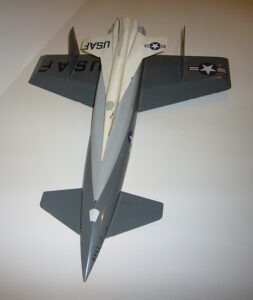
Still surviving over 60 years later, is the Bell in-house constructed model of their MX-2276 BoMi or Bomber Missile. Its gestation period of 10 years required, even demanded, input from a hypersonic research aircraft in order to birth as hardware and fly. (Tim O’Keefe photo)
Great Expectations; North American’s Exotic
Advanced X-15 Concepts – Part I
The
X-Plane Birthed
One of the most successful ongoing NACA-NASA projects is their
experimental research aircraft series. A highlight was the stunning
success of the NASA/USAF backed North American Aviation hypersonic X-15
research program. The "X" program was birthed during a secret
conference on December 18, 1943, in Washington, D.C., where Mr. Bob Wolf,
Bell Aircraft assistant chief design engineer, made the case for a gas
turbine powered "high speed flying laboratory."1
Bell’s XP-59A twin-turbine powered jet fighter had been flying at the
secret Muroc Dry Lake Test Site since September 29, 1942. (Bell test pilot
Robert Stanley performed three unofficial "high-taxi" lift-offs
between one and two feet above the dry lake surface – thus actually flying
before the official October date.)
Larry Bell having flown in the "up front" instrumented open
cockpit and passenger seat of the XP-59A at the Muroc Dry Lake facility
was pleased with the flight tests. He and his engineers were confident
they could design and construct a high-speed research aircraft to confirm
advanced engineering and construction techniques, and contribute to
America’s high-speed aircraft database. On December 29, 1943, Larry Bell
sent a letter to Dr. George W. Lewis, director of the NACA’s
aeronautical research division, suggesting a high speed flying laboratory.2
Douglas Aircraft had been offered a contract to built such an aircraft but
refused. So, on November 30, 1944, Bell’s Bob Woods visited Major
Kotcher at Wright Field and accepted the contract for what became their
Model 44 or XS-1 also known within the USAAF as Project MX-524 cum MX-653.3
Further meetings with NACA and USAAF officers of the Air Technical
Services Command at Wright Field fleshed out the airplane’s parameters;
it would penetrate the so-called "sound-barrier" or high-Mach
numbers to approximately 800 mph, using liquid fuel rocket engines as a
power source. On December 4, 1944, Robert Woods and chief test pilot
Robert Stanley took an oath of secrecy and initiated the XS-1 project.4
The meetings included Bell Aircraft engineers Bob Woods and Benson Hamlin
(a young excellent engineer engaged in designing the XS-1, who later
teamed with chief engineer Casey Forrest to design the stillborn Bell X-16
high-altitude reconnaissance aircraft, and the exotic classified
hypersonic SR-126 Robo or Rocket Bomber during the late 1950s, Hamlin
. . .