
Flight of an F-4E with Wings Folded
Gerald Asher
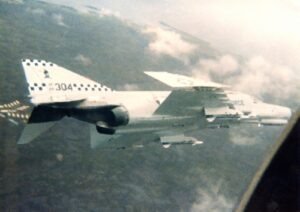
During the flight of #304 with the wings folded. (Jim Uken photo from the author’s collection)
Flight of an F-4E with Wings Folded
August 1, 1978, I was almost halfway through my oneyear
tour with the 57th Fighter Interceptor Squadron
"Black Knights"Â at Keflavik, Iceland, and, in spite of
the relatively dreadful climate, I was enjoying just about every
minute of it. I was an aircraft mechanic working on fighters,
serving a viable mission as we kept watch on Soviet aerial
activity in the Greenland-Iceland-United Kingdom (GIUK)
Gap. It was a far cry from my first assignment fresh from
technical training school, where I was assigned to a small fleet
of North American T-39 Sabreliners in Colorado Springs. Most
of my time there seemed to be spent cleaning, polishing, or
handling bags for a seemingly endless stream of high-ranking
officers and other dignitaries; needless to say, I became a bit
disillusioned. No doubt prompted by a lack of immaturity in
understanding that there was more to the Air Force than combat
aircraft, certain among my superiors felt I was developing an
attitude problem. My orders to Iceland – the third choice on
my "dream sheet"Â – were tantamount to a Death Row inmate
receiving a pardon, for me.
My first four months at Keflavik were spent on an alert crew.
Two six-man teams split a 48-hour on, 48-hour off schedule;
four of the members were generally junior enlisted (E-3s and
E-4s) with two more senior enlisted assigned in a supervisory
capacity. Flight crews – two pilots and two Weapons System
Officers (WSOs) – rotated every 24 hours. The alert crew’s
sole job was to launch and intercept any Soviet aerial activity
that ventured into the GIUK gap. Usually it was Tupolev Tu-
95 "Bear D"Â bombers rotating between Murmansk and Cuba.
Other times it was Soviet maritime surveillance aircraft – Tu-95
"Bear F"Â bombers and Ilyushin IL-38 "May"Â patrol bombers –
venturing out to monitor U.S. Navy fleet activities in the North
Atlantic.
I Was in Heaven
When I first arrived, the squadron was operating the F-4C
Phantom II, many of them having served in combat during the
war in Southeast Asia (SEA). There were even a few "MiG
killers"Â in the bunch – and one, "666,"Â that was rumored to
have virtually landed itself when the crew ejected on short final
after one too many warning lights came on. I never found out
if the story was true, but you know the difference between a
fairy tale and a war story, don’t you? The fairy tale begins,
"Once upon a time"¦" and the war story starts out, "Now this
is no sh"¦"Â
Two months into my tour, we exchanged our tired "ËœC’
models for somebody else’s tired "ËœE’ models. Transitioning
between aircraft sub-types in what was essentially a combat
theater (that "ËœCold War’ thing) tends to tax existing assets insofar
as the ability to meet mission requirements. To help alleviate . . .
This article costs $5.00 to download - or it's free for AAHS members.
Already a member? Sign in to download for free.