
Elephantine but Silent: U.S. Army Cargo Glider Development, Part 2
William Norton
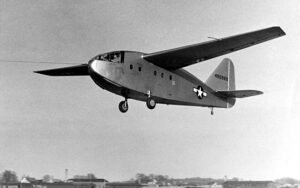
A departure from the coarse and ugly cargo gliders of the early war years was the Chase XCG-14. Built of wood in a very clean aerodynamic form, it permitted tow to 170 mph with 16 troops or 4,000 lbs of materiel. (National Soaring Museum)
Elephantine but Silent: U.S. Army Cargo Glider Development, Part II
With the development of the 8- and 15-place cargo transport gliders well in hand, the Army turned its attention to larger aircraft with twice or more the payload capacity of the Waco CG-4A. The first officially enunciated desire for a 30-place machine was communicated in July 1942. The larger gliders were to be configured for unloading within 15 seconds of landing. Despite their size, the aircraft still had to be capable of being disassembled and crated for shipment overseas. Curtiss C-46
Commando and Douglas C-54 Skymaster aircraft were soon to become available for tow, making such large gliders practical, provided they had a tow speed to
match.
Air Materiel Command’s Colonel Fred Dent had seen the
Horsas and Hamilcars the British were building and, given the rapid growth of the U.S. Army airborne forces, expressed the conviction in late 1941 that gliders had to be acquired capable of transporting such cargo as 30 troops, two jeeps, a jeep towing a 75-mm gun, or other bulky cargo. The Army’s 105-mm howitzer had been redesigned to fit inside the CG-4 and C-47, reducing its dimensions and cutting weight to 2,500 lbs (1,134
kg).
Tests in August 1943 demonstrated that a C-47 could tow a normally loaded
Horsa "¦ just barely. The British used second-echelon bombers. These results encouraged use of the glider by the U.S. Army for lifting large-caliber weapons needed in invasion beachheads to deter an initial German counterattack. Consequently, more than 300 Airspeed AS.51
Horsas were acquired and the pilots initially trained in March 1944. As a measure of comparison against American counterparts, the
Horsa seated 25 troops and two pilots, and was towed at up to 160 mph (139 kts). Maximum loading for . . . . . .
This article costs $5.00 to download - or it's free for AAHS members.
Already a member? Sign in to download for free.