
Doing the Wright Thing
Ken Keisel
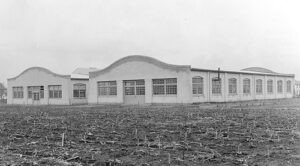
In November 1910 the Wright Co. moved into Building #1, a single-story 4,000 square foot building designed to resemble a hangar. Building #1 (left) was constructed in a cornfield on the south side of West Third St. along Coleman Ave. 1.5 miles west of the bicycle shop. In 1911 a second identical building (right) was constructed alongside. The additional building made it possible to produce four airplanes a month, the largest output of any aircraft manufacturer of the time. (Courtesy of United States Air Force photo collection)
It should
come as no surprise to readers that the first
airplane factory was founded in Dayton, Ohio,
or that it bore the name Wright. What may come
as a surprise is that those original buildings
still stand, and until three years ago they
were still part of a functioning factory.
The Wright Co.
Building 1 was only the fifth structure ever
constructed by the Wright brothers for their
aircraft. It followed the two wooden buildings
the brothers constructed at Kitty Hawk, N.C.,
in 1900 and 1903, and two hangars constructed
in 1904 and 1906 at the Huffman Prairie in
Dayton, Ohio. The Kitty Hawk hangars were left
to the elements, and vandalism, while the
Huffman Prairie became part of Wilbur Wright
Field, the last hangar being demolished by the
Army Air Corps in 1937. With their demise, the
National Park Service now considers the Wright
Co. Building 1 to be the world’s oldest
surviving structure constructed for powered
flight. In 2012 it became the focus of a
National Park Service plan to turn the Wright
brothers’ first airplane factory into a museum
complex dedicated to the history of early
aviation in Dayton, Ohio.
The Wright
Company
Wilbur and Orville
Wright had been trying to sell their Wright
Flyer to the U.S. Army since 1905, but not
until February 8, 1908, did the Army Signal
Corps finally accept a bid from the Wrights
for an observation aircraft, with the
specification that it be capable of flying 40
mph for 125 miles while carrying two persons.
Despite Orville’s disastrous crash in 1908,
the brothers delivered their first "Military
Flyer"Â to the U.S. Army Signal Corps in 1909,
receiving $25,000, plus a $5,000 bonus
for completing all requirements ahead of
schedule. The Army contract meant the brothers
could finally move out of their bicycle shop
and build an aircraft factory in Dayton. In
late 1909 Wilbur and Orville collected
$400,000 from a group of New York investors,
and the Wright Co. was incorporated on
November 22, 1909.
Initially, the
company occupied a rented corner of the
Speedwell Automobile plant on Essex Avenue
(now Wisconsin Boulevard), an industrial area
in southwest Dayton. Speedwell was one of six
automobile manufacturers located in Dayton at
the time. The Speedwell factory was only
intended as a temporary site while the Wright
Co.’s first factory building was being
constructed. At the Speedwell site the Wright
Co. produced the Model B Flyer, the world’s
first mass-produced
airplane, and the Model R, a single-seat
racing version of the Model B. Meanwhile,
Charlie Taylor, Wright’s chief mechanic,
continued to build the Flyer’s engines in the
back of the West Third Street bicycle shop.
The original location of the Speedwell
Automobile plant is now a vacant lot at the
southeast corner of Wisconsin Blvd. and Miami
Chapel Rd. It is marked with a metal sign
indicating its importance.
In January 1910 the
Wrights broke ground for the first building
ever constructed for the purpose of
manufacturing airplanes. The site was in a
cornfield on the south side of West Third St.,
about 1.5 miles west of the Wright’s bicycle
shop. The one-story structure was modest,
incorporating
a curved roof that resembled an airplane
hangar. Inside, it . .
.
This article costs $5.00 to download - or it's free for AAHS members.
Already a member? Sign in to download for free.