
Crunch Aluminum, Rebuilding a Boeing 747-200B in Alaska
David Stern
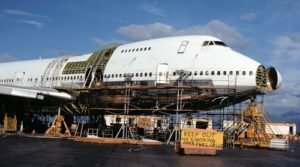
Several workers are seen in this photo taken weeks later showing the new replacement formers, stringers and skins painted zinc-chromate yellow. Plenty of lighting was positioned where necessary aiding the AOG night crew in their work. (Photo by the author)
Crunched Aluminum, Rebuilding a Boeing 747-200B in Alaska
The night of December 16, 1975, was dangerous for both man and machine at Anchorage International Airport, Alaska. Treacherous high winds in the form of a dangerous mini-Chinook (Alaskans called them Aleutian Williwaws), drove mixed rain and sleet at gusts of 40 knots, occasionally reaching 60 knots, which coated the ramps, runways and taxiways with a slick glaze of ice. Japan Air Lines DC-8s and 747s landing daily often departed during the winter nights when no sunlight could melt and evaporate the slick ice coating everything that evening. During this inclement weather the JAL’s Boeing 747-200B, JAL 8122, s/n 20924, was pushed by ramp tugs away from the main terminal. It was disconnected and under its own power slowly trundled along the parallel taxiway to the east-west runway. The author observed the aircraft slowly disappear into the darkness. ÂÂ
Shortly thereafter the tower never answered calls to clear a DHC Twin Otter waiting to taxi off the dangerous windy ramp to its base. Instead, a convoy of airport security and other autos plus several fire trucks with their rotating beacons on rapidly moved down the taxiway toward the western end of the runway. It was soon learned that while moving along the taxiway high wind gusts slewed the 747 into a 90-degree rotating turn, due to the huge fin-rudder acting as a weather vane. The aircrew quickly implemented emergency procedures that included shutting down all four engines. Now without power the high winds and gusts literally shoved the giant aircraft into an uncontrolled rearward skid off the taxiway, through a 13-inch snow-berm, over an embankment and down into a gully. When the 747 finally stopped moving it was found to be straddling the gully with all four engines jammed against the ground, thus preventing any further movement. The violent rear slide injured Captain Kaneda, another crewman and nine of the passengers – fortunately not fatally. They were evacuated off the 747 and taken to the hospital.
“Ragan’s Raiders”
During this time period the Boeing Commercial Airplane Co. created a customer support group known as “Ragan’s Raiders,” officially known as the Boeing AOG (Aircraft on Ground) Team. Their prime duty was to minimize further damage while moving a damaged Boeing transport to a safe area for rebuilding. The team had already accomplished the rebuild of a Boeing 747 at Athens, Greece, completed in December 1975, and now possessed valuable field experience. They were ready when the Boeing Co. immediately dispatched an engineer from their Maintenance and Ground Operations Systems Division (MGOS) who arrived the next day to inspect the aircraft. He examined the severely damaged lower fuselage surfaces and a large quite visible crack running along each side of the 747’s spine below the lounge area. Three of the . . .ÂÂ
This article costs $5.00 to download - or it's free for AAHS members.
Already a member? Sign in to download for free.