Col. Charles W. Stark: From Horse Artillery to Turboprops
Cal Taylor
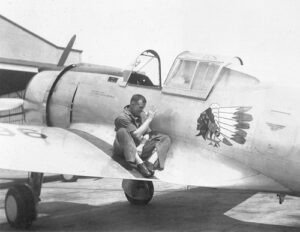
Stark at Selfridge with a 94th Pursuit Sq. P-35. (Photo from the Stark archives)
Col. Charles W. Stark: From Horse Artillery to Turboprops
Beginning his military career in the National Guard horse artillery, Charles W. Stark served in the Army, Air Corps, the Army Air Force and the United States Air Force. He saw military aviation progress from fabriccovered airplanes to Century Series fighters, multi-engine transports and a multitude of aircraft types. He was a unit commander of fighter squadrons, air divisions and wings and saw combat in WWII and the Korean War. In other assignments, he was central to fighter development and evaluation. His active duty career began with graduation from the United States Military Academy Class of 1937 and concluded on July 31, 1961. Following retirement, he was an orange grower in Mexico for nearly 30 years before moving to Olympia, Wash., in 1993. There, he died peacefully on October 14, 2006.
The Younger Years, 1912-37
Nine years after the Wrights made their first flight, Charles W. Stark Jr., was born in Asbury Park, New Jersey. His parents were Elizabeth Sutton Stark and Lt. Col. Charles W. Stark, later head of the Ordnance Department of the New Jersey National Guard (NJNG) and the 44th Division.(1) At this early time in aviation, such names as Avro, Curtiss and Deperdussin were already familiar in the world that Charlie Stark would enter. Stark, nicknamed “Bumps,” saw very early something of the military life, when he and his mother visited his father at NG activities.
By Stark’s seventh birthday, his father was in Bourbonne-les-bains, France, remaining there until early 1919. In April, Lt. Colonel Stark’s homeward journey took him through Glasgow, Scotland. During a National Guard summer camp, at Sea Girt, N.J., Charlie Stark had his first airplane flight. This was probably in the years 1922-24. He sat on his father’s lap in the front cockpit of a JN-4 Jenny flown by an unknown pilot, though Stark always maintained it was Charles Lindbergh. Lindbergh did not solo until May 1923 and joined the air cadet program on March 19, . . .
This article costs $5.00 to download - or it's free for AAHS members.
Already a member? Sign in to download for free.