Charlie Forty-Six, Some Exploits Told, Part 2
David Stern
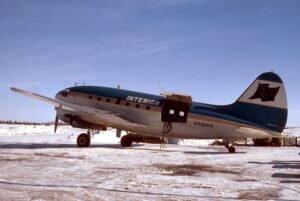
Interior Airways had an eye-appealing livery on most of their aircraft. Their blue, grey, white and gold colors are seen in this early 1971 winter photo of C-46, N-4860V, on the Fairbanks Airport ramp. When the Seven Sisters accelerated exploration and construction of the North Slope oil pipeline project, Interior was purchased, becoming Alaska International Air (AIA). (Photo by Dave Stern)
Charlie Forty Six,
Part II: Some Exploits Told
In the late 40s,
U.S. military operators retained ownership of some C-46s and leased them
to qualified operators, but declared others surplus, while those retained
in military service flew well into the 1950s, before retiring. In 1948,
Claire Chennault and Whiting Willauer, founded CAT (Civil Air Transport)
using surplus C-46s and several C-47s.
In December 1949, CAT Commandos and Skytrains
escaped the Communist seizure of mainland China by evacuating all
personnel and aircraft to bases in Hong Kong, Formosa, and Tachikawa. CAT
fought legal battles concerning ownership of their grounded aircraft in
the Hong Kong courts, but eventually shipped their corroded transports to
a salvage yard in Santa Barbara, where they were sold piecemeal as spare
parts.(1)
In America, the War Assets Administration
decision to surplus C-46 and C-47s stymied Curtiss plans to produce their
CW-20 civil transport. The ironic twist is that surplus Commandos fulfilled
the CW-20’s planned role by flying cargo and passengers in the U.S.,
Central and South America, Asia, and Alaska, but not with the CW-20’s
planned interior appointments and "stepped windshield."
Hundreds of civilian and ex-military pilots
initiated non-scheduled charter passenger and freight lines, with surplus
C-46s, especially in the Pacific Northwest and Alaska.
Non-scheduled passenger and freight lines such as
Talon, MAT, the man-wife team of Arctic Pacific Inc., Skycoach Express,
All American Airways, U.S. Aircoach, Coastal and Air Transport Associates
(ATA) briefly flew Commandos before ceasing operations due to the
post-war glut of start ups. ATA charged a mere $69 to fly Seattle to
Anchorage, and only $60 southbound return.
Even Transocean Airlines folded. That airline,
the brainchild of a reported 19 mixed USN and USAAF pilots flying
operations in Okinawa prior to the surrender, was based in Oakland, Calif.
A successful but secret Transocean contract involved flying 45 tons of
Siamese gold from Tokyo, Japan, to the Federal Reserve Bank in New York,
with fuel-oil stops in . . . .
This article costs $5.00 to download - or it's free for AAHS members.
Already a member? Sign in to download for free.