
"Black Sunday," April 16, 1944
Carroll "Bob" Anderson
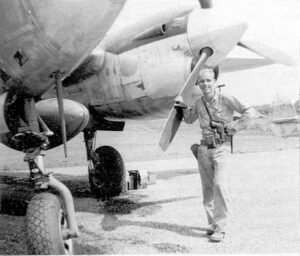
The author, Lt. Carroll "Bob" Anderson. (Photo from the author’s collection)
“Black Sunday,” April 16, 1944
The story of April 16, 1944, Black Sunday, is a truly harrowing story about hundreds of aircraft being forced to fly though a severe and unexpected weather front that blocked their path home. Many crashed, unfamiliar with purely instrument flying. Others ran low on fuel and crashed into thick jungle, mountains, or the water of Papua New Guinea’s Madang Province.
At the time of the raid, the aircraft were staged out of a number of bases, including Gusap (A-20s), Finschafen, Lae and Nadzab (B-25s and P-38s). With a combat range of 985 miles, the 888 mile round trip from Gusap to Hollandia was pushing the A-20s to their limits. The P-38J models were eventually more than capable of combat ranges of 2,000 miles, but it would take Charles Lindbergh’s visit to the 475th Fighter Group in the summer of 1944 to teach the pilots skills necessary to obtain these. At the time of Black Sunday, they had poor fuel management operating procedures, so the Hollandia mission gave them smaller margins in fuel reserves. Added to the fuel issue was that many of the pilots had marginal training and practice in instrument flying, with the storm front pushing their skills to their limits.
The squadrons of returning U.S. Fifth Air Force aircraft had no choice but to take on the front as it lay across the demarcation line between the enemy and the safety of their home bases.
Black Sunday represents the largest weather-related loss in combat aviation history, yet ironically not one aircraft was lost to the Japanese.
The following story provides insight into the experiences pilots of the 433rd Fighter Squadron of the 475th Fighter Group on that day.
To those fliers and crewmen who participated in this eventful flight, the day will live forever. Most disasters unfortunately live on in history, and this particular day and event must qualify for the somewhat dubious honor of this classification.
To me, what makes this story interesting is the fact that today’s navigational aids have improved to the point where any pilot lost within the confines of the continental United States in an aircraft equipped with radio and the basic blind flying instruments can be brought in to a safe landing. Seventy plus years ago with the finest aircraft, radios, and blind flying equipment, a pilot lost in bad weather trusted to luck and hoped his ETA would run out over his home base.
The advances made in navigational aids within the past years are amazing, and it is with these great strides in mind, I write this story as a reminder to those who have forgotten what it used to be like in years gone by.
April 16, 1944
To the ground crews and pilots of the Fifth Air Force in New Guinea, Easter Sunday 1944 dawned just as dozens of other days in the months past. It was noticeably hot before the sun rose over the jungle covered Finisterre Mountain Range to the East, and long before its rays touched the arid Markham Valley, crewchiefs were at work on the A-20s, B-25s, B-24s, P-40s and P-38s. The rumble of pre-flighted engines filled the air. ·The staccato bark of the Wright-powered B-25s contrasted . . .
This article costs $5.00 to download - or it's free for AAHS members.
Already a member? Sign in to download for free.