
Beech Bonanza History, Part 1: <br>80-Year Reign of the World’s Longest Continuously-Produced Aircraft
Richard Harris
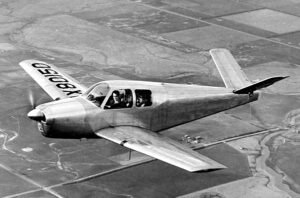
Prototype #3, NX80150, with the laminar flow wing and Lycoming power. Believed to have been lost in flight testing due to a failure of the gear door during a dive. (Beech photo, AAHS archives, Gerald Balzer collection)
Beech Bonanza History, Part 1:
80-Year Reign of the World’s Longest Continuously-Produced Aircraft
The Beech Bonanza – a fast, 4-6 seat single-engine light plane, arguably the first fully modern light plane – is a marvel of aviation history. It is reputedly the longest continuously-built aircraft in the world.[1] First on the scene in 1947, it amazed the lightplane world with its advanced mix of modern features: sleek, all-metal (aluminum) hollow-shell (semi-monocoque) construction, retractable tricycle landing gear, variable-pitch propeller, 165-horsepower, flat-six engine, complete instrumentation for blind flying, and airliner speed for four people. It was made all the more distinctive by its unique V-shaped tail.[2]
It took the aviation community by storm. While most prewar lightplane makers – Piper, Aeronca, Taylorcraft, Luscombe, Stinson, Ryan, Fairchild, etc. – in the postwar recession shrank, collapsed, suspended operations, went out of business, sold out to others, abandoned the lightplane market, and/or transitioned into other industries, Beech slowly blossomed.[3]
Over the next seven-and-a-half decades, the Bonanza evolved into straight-tailed and 6-seat variants, acrobatic models, two-seat military trainers and drones, turbo-charged speedsters – plus various twin-engine derivatives even including a pressurized version.[4]
Since 1947, over 18,000 Bonanza variants, and 6,000 twin-engine derivatives, have been built and found service in nearly every country in the world, with most still airworthy today. Directly or indirectly, most of the legendary line of postwar, modern, all-metal, prop-powered Beechcraft designs can trace their origins, at least in part, to the Bonanza.[5]
Textron, as the new parent company, is shifting its focus to more modern, expensive, and profitable turboprops and jets. It has announced that production of this aviation icon will come to an end, as soon as the last outstanding orders are filled.[6] It’s time to note the incomparable milestone, reflect on this historic aircraft, its origins and developments, its impact on aviation, and the forces that shaped it, sustained it, and brought it to this moment.
The Company
Beech Aircraft Co. was formed in 1932 by Walter Herschel Beech and his wife Olive Ann, with engineer Ted Wells. Walter’s storied career, barnstormer-to-businessman, spanned the pioneering companies of the "Air Capital City," Wichita, Kansas: Laird/Swallow (America’s first mass-produced "commercial" airplanes, under Matty Laird and Jake Moellendick), and Travel Air (formed with Clyde Cessna and Lloyd Stearman, America’s highest-volume planemaker by 1929), and his own namesake Beech Aircraft Co., emerging in 1932 from the Depression-era ashes of Curtiss-Wright’s 1929 acquisition of Travel Air.[7]
At the top of Beech were a handful of powerful decision-makers. Its legendary founder, Walter Beech, was in his later years crippled by a coma-inducing encephalitis in 1940. He increasingly handed most management responsibility to his wife and co-founder, Olive Ann. She was a shrewd, stern, disciplined businesswoman, who managed to wrangle $63.5 million in government and bank loans ($1,460 million in 2025 dollars[8]) to finance Beech’s ten-fold expansion for war production. "She ran the place," workers have reported. Olive Ann, in turn, delegated much authority to trusted V.P. and General Manager Jack Gaty.[9]
But Walter made his presence felt, and frequently strolled throughout the vast Beech factory complex, especially the experimental and engineering offices, asking questions, and keeping staff on their toes. Later generations of practical . . .
This article costs $5.00 to download - or it's free for AAHS members.
Already a member? Sign in to download for free.