
"Back From The Dust Bin Of History," Restoring The Burnelli CBY-3
Thomas C. Palshaw and Harry Newman
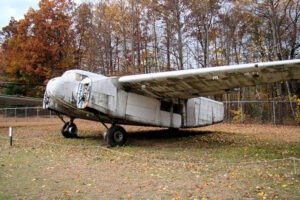
The Burnelli CBY-3 at the New Enlgand Air Musuem prior to restoration. (Photo from Tom Palshaw)
“Back From The Dust Bin Of History,” Restoring The Burnelli CBY-3
The Restoration Beginning
Very early in our restoration we were in contact with The Friends of Beacon Field Airport, an organization dedicated to preserving the history of Beacon Field.
In July of 1957 the Burnelli CBY-3 was being demonstrated to the U.S. Army at Fort Belvoir, Virginia. Both engines quit on the second high performance takeoff and the aircraft belly landed back on the runway. The aircraft was trucked to Beacon Field where it was repaired by Mr. “Junie” Marshall and Mr. Paul Zimmer before it was ferried out to Baltimore. Harry Lehman and Anna Marie Hicks had a number of photographs of the aircraft that they shared with us including a very rare photo of the cockpit interior. You can visit The Friends of Beacon Field Airport website at http://www.beaconfieldairport.com.
Larry Pope of Austin, Tex., has had a long interest in Burnelli’s blended wing designs and contacted us shortly after our restoration began. Larry has compiled an impressive collection of printed material and photographs pertaining to the CBY-3 and had provided us with several rare high quality color photographs and supporting material. We are using these color photos to guide us in reproducing the color scheme for our finished display. You can see Burnelli’s planes and designs along with some of what Larry is doing at www.burnelliaircraft.com. He has also been in contact with The University of Texas, and has discovered a comprehensive flight evaluation dating from 1953 that he has forwarded to us.
“Field Expedient Repairs” (FER’s)
When the CBY-3 restoration began our team was faced with several issues with the aircraft’s overall condition including preexisting structural damage, widespread pockets of corrosion and wear and tear from the time it was in service – often operating out of rough airstrips. All of these conditions proved to be challenges for our crew. The “wear and tear” issues – of which there were many – presented our crew with decisions about which issues should be restored and which should be left as they were found since they represent an important aspect of the CBY-3’s operational history. Adding to this history has been the ongoing discovery of numerous “field expedient repairs,” which our crew has dubbed “FERs.”
Faced with hull punctures and tears while operating in very remote areas, the CBY-3 crews and mechanics apparently used whatever materials were available to cope with the damage and return the aircraft to operation, perhaps with the intent to make permanent repairs at a later date.
Since it is not our intent to return the CBY-3 to flying condition, our approach during this restoration has been to preserve many of the FERs in situ, while repairing or replacing those where the aircraft’s structural integrity was impacted. Where a FER was located on a skin panel that requires replacement due to widespread corrosion, the FER would not be preserved or reproduced. In one instance a FER was found where a long piece of steel angle-iron was bolted in place to span a damaged area along an aluminum structural channel in . . .
This article costs $5.00 to download - or it's free for AAHS members.
Already a member? Sign in to download for free.