
Arctic Operations, Part IV
David Stern
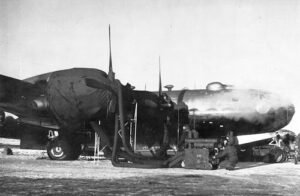
Winter Ops at Ladd Field. This unidentified F-13 is being heated by a period "space-heater" or "Herman-Nelson" with multiple hoses. The custom engine cowling covers will keep the engines and oil tanks warm long enough for all of the engines to easily start. The ground-crew wear the latest Alaska-Arctic fashion clothing, heavy military parkas. (Photo from Col. B.C. Barris, AWRA)
LONG RANGE PACUSAN
In December 1945, USAAF Col. C.S. “Bill” Irvine queried Wright Field’s Engineering-Procurement Division with questions on how to modify a standard B-29 into a 10,000 mile range bomber. The focus was upon fuselage structural modifications, increasing fuel capacity, re-rigging for Arctic flight and special instruments for transpolar flights. Appropriate to the Polar Concept being defined in the Pentagon, Colonel Irvine’s modification plan was also approved there. He chose a faster, light weight B-29B (44-8601) one of 311 Bell-Marietta built minus guns and fire control systems, named Pacusan.
Colonel Irvine previously set a 1945 non-stop record flight from Guam to Washington D.C., an 8,198 mile trip in Pacusan. Funds were approved for Air Material Command (AMC) to procure and install the necessary equipment for Pacusan’s modwork at the Tinker Field Oklahoma City Modification Center.(1) Four new Wright R-3350CA-2 fuel injected engines were installed, bomb-bay door retract accessories were removed and two huge rigidly-laminated nylon fuel tanks were installed – one in each bomb bay.(2)
Pete Bower’s first edition of Boeing Aircraft since 1916 displays one photo of Pacusan renamed upon completion of the modifications to Pacusan Dreamboat. Outwardly noticeable were the reengineered “Andy Gump” engine nacelles with repositioned and modified carburetor air intakes plus threebladed props.(3) Some landing gear strut metal was removed including the anti-icing system and deicer boots, the original B-29 tail and fuselage cone was replaced by a streamline tail cone and vertical fin-rudder from the new Boeing C-97 cargo transport production line. Hydraulic lines were removed and winterized with stronger lines to withstand higher fluid pressures while flying the Polar Regions, plus electrical instruments replacing the vacuum actuated instruments for greater accuracy and special brake linings.(4) Also installed . . .
This article costs $5.00 to download - or it's free for AAHS members.
Already a member? Sign in to download for free.