Ancestor Aircraft of TWA, Part 3
Edward Peck
A replica of the Hughes Racer, NX258Y, at the Reno Air Races in September 2002. (Photo by Al Hansen)
Ancestor Aircraft of TWA, Part 3
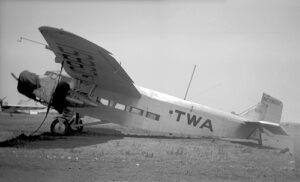
Probably no other aircraft names are more intimately associated with early airlines in the United States than Fokker and Ford. The trimotored models of these manufacturers came into very wide use during the late 1920s when independent and mail-subsidized carriers began to plumb the potential of transporting passengers in volume. Cramped, drafty airplanes were altogether adequate for flying canvas mail bags heaped one upon the other, a pilot bundled in fleece-lined leather, and the occasional hardy adventurer who traveled by air. Ladies and gentlemen who ventured aloft preferred something a bit less rustic. Thus arose the need for airplanes that one could enter gracefully, sit in with reasonable comfort, and ride into the sky surrounded by the reassuring roar of three big engines.
Before the vogue in trimotored airplanes gained momentum, Fokker was building smaller, single-engine aircraft that found favor with many scheduled operators of that day. Its Universal
and Super Universal monoplanes accommodated only a half dozen or so passengers but blazed a trail soon followed by the larger F-10 and F-10 Trimotors. In the mistaken belief that a still larger airplane would automatically lure even more passengers into the air, the four- engine F-32 was developed. It was an eye-popper. It also ate deeply into an airline’s operating budget and posed such troublesome technical problems that it quickly became something of a “white elephant” and was discarded.
The trimotored Fords had an even greater impact on early airline development in America. By blending a proven overall design concept with the obvious advantages of all-metal construction, they were attractive airplanes to operators and passengers alike. From the smaller 4-AT Ford a more imposing 5-AT model evolved in much the same fashion as Fokker had enlarged its earlier version of the Trimotor.
The Fokkers and Fords will long be remembered for their roles in helping an infant airline industry secure a firm footing. There were other airplanes of similar size and appearance that did not fare so well. Among these was the stately Keystone Patrician. Like a nova star, it burst into momentary brilliance then quickly faded into oblivion.
TWA or its predecessors used all of these aircraft. Their grouping together here is a coincidence of the alphabetical approach adopted for this study but may also facilitate a direct. . .
This article costs $5.00 to download - or it's free for AAHS members.
Already a member? Sign in to download for free.