America‘s Local Service Airlines, Part I
David H. Stringer
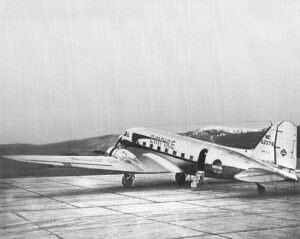
Empire Air Lines replaced their Boeing 247s with five Douglas DC-3s, including NC62376 seen here. They would merge with West Coast Airlines in 1952. (From the author’s collection)
America’s Local Service Airlines, Part I ÂÂ
Many folks today do not realize that, in the 1950s and 1960s, the United States was blanketed by a group of air carriers that served virtually every nook and cranny of the Lower 48 states. Residents of smaller cities, such as Hazleton, Penn., Moultrie, Ga., and Gallup, N.M., could board a 24-28 passenger Douglas DC-3 at their hometown airport and be on their way to any place else in the world. The 13 airlines certificated to provide this convenience eventually wound up serving more than 580 cities in the U.S. with a fleet of more than 400 aircraft.
These Local Service Airlines, as they eventually became known, were given birth by the Civil Aeronautics Board (CAB). In 1943, the CAB undertook a mission to investigate the possibility of extending scheduled air service to smaller cities and towns throughout the United States even if the service to some of these communities might not be economically viable. This was an incredibly progressive undertaking for a government agency. America was in the midst of WWII. The nation was becoming "air-minded"Â and the members of the CAB knew that, once the war was over, every city and town would want to be on the airline map with this new industry carrying the weight of importance that the railroads had shouldered in the 19th century. Providing transportation to isolated towns and implementing air service to communities near military installations in support of national defense were additional reasons for examining the potential of this new type of air carrier.
In order to make routes into smaller cities attractive to airline entrepreneurs, government aid would be offered in the form of subsidy for carrying the U.S. air mail. When the war ended there would be hundreds of freshly-trained pilots returning to civilian life looking for jobs. There would also be an assortment of war surplus aircraft available. With these three forces at work: subsidy, manpower, and affordable aircraft; the seeds were planted and the timing was right.
The CAB issued its opinion in the summer of 1944, stating that, indeed, this new level of air service should be instituted on an experimental basis. There would be a whole new set of certificated carriers to be called "Feeder Airlines" because their primary purpose would be to transport passengers from smaller cities and towns to the big airports where those passengers would be fed to the trunk airlines for their onward journeys. By this time there were already hundreds of applications on file for different forms of air service to small cities and towns. In addition to feeder airline proposals using fixed-wing aircraft, there were helicopter service presentations, plans for mail pick-up service and schemes by companies associated with railroads and bus lines for air service to be coordinated with their primary businesses. In addition, the established trunk airlines were very wary of creating a whole new set of airlines when they felt that they could handle the feeder service proposal themselves. But the CAB wisely decided that an entirely new and experimental concept should be carried out by new outfits that would have to prove themselves capable. Their operations would be scrutinized every few years to determine if their certificates should be renewed. The Board felt that large carriers concentrating on bigger markets would  . . .
This article costs $5.00 to download - or it's free for AAHS members.
Already a member? Sign in to download for free.