
Allison’s Contribution to Supersonic Propeller Research
John M. Leonard
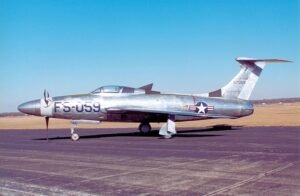
The Republic XF-84H "Thunderscreech" (Allison photo 74078)
Allison’s Contribution to Supersonic Propeller Research
In the course of aircraft design, many ideas are tried. Some work well, and continue to be incorporated in new designs. Some work well enough, but are superseded by even better ideas. Others are tried but testing reveals unexpected problems that made the ideas unacceptable. This article is about two ideas that were tried but never made it through the test phase – primarily about supersonic propellers but also with consideration of afterburning turboprops used in conjunction
with supersonic propellers.
Supersonic propellers were developed in an attempt to allow propeller-driven aircraft to operate at higher speeds – into the transonic speed regime. In order to do this efficiently the blades had to be very thin and rotate at higher speed, with tip speeds as high as Mach 1.81 if the aircraft forward speed was high enough. Because studies performed by the NACA and propeller companies showed promise for supersonic propellers, there became a need for flight data to prove the concept. The XF-88B and the XF-84H were built and used to test supersonic
propellers.
Probably because the Allison Division of General Motors was a leader in large turboprops in the 1950s and had experience in gearbox design going back to the Liberty engine days, it became involved in developing hardware for supersonic propeller test programs. Aeroproducts was also a division of General Motors, and their experience in developing propellers made them a good match for participation in this effort. At the beginning of the effort it would be fair to say that there was optimism in the potential for supersonic propellers. In the end it appears that the noise made by supersonic propellers made them unacceptable for use, and research ended by 1957. Over time much of the information on this program has been lost, and by now many (or perhaps most) of those who worked on the program are gone. This article is an attempt to document some of this work based on information that has been found, primarily in the archives of the Rolls-Royce Heritage Trust, which contains some of the records from the old Allison
Division of GM.
Introduction
Most propellers operate with their tip speed below the speed of sound. This is because when the tip speed becomes supersonic it produces shock waves, which increase the drag on the propeller, thus requiring more power, which reduces propeller efficiency. Table 1 shows the tip speed for several propellers in order of decreasing maximum propeller tip Mach number. These numbers were computed at the maximum propeller speed and the maximum aircraft speed, so they
represent worst-case conditions.
It may be noted that the C-133 had a supersonic tip speed when flying at its maximum speed, but this was apparently not without its problems. In Reference 1 it is stated that: “If the . . . .
This article costs $5.00 to download - or it's free for AAHS members.
Already a member? Sign in to download for free.