
2 MiGs versus 1 PBM
Dave Rinehart
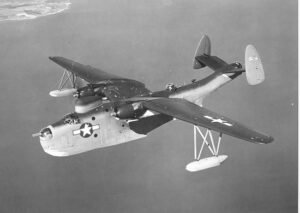
A Martin PBM-5 Mariner is similar to the PBM-5S2 that the author describes in this article. (Photo USN/Martin via Bruce Barth )
Never let it be said shanghaiing was not practiced by the U.S. Navy in the 1950s! My only personal involvement with this practice began on Oct. 1,1953. I was in Crew 5 of Patrol Squadron 50 deployed to NAS Iwakuni, Japan. We mustered as usual at 0800 in the hanger area down by the seaplane ramp. Following muster we were treated to the monthly payday and I recall taking out about $110 in military payment script. More about my money
later.
VP-50 had 12 PBM Martin Mariner flying boats and 12 flight crews. These aircraft were getting a little long in the tooth, the type having performed all through WWII after being first flown in 1939. Very few aircraft flew operationally both during WWII and a couple of years past the Korean War. Our planes were pure flying boats, meaning no landing gear, so we had to operate strictly from water. The PBM only had two engines but they were R-2800S rated at 2100 hp each. Their 118-foot wingspan was greater than its contemporaries, the famous B-17 and B-24 four engine bombers. Our patrol weight was upwards of 50,000 pounds that required the use of four JATO bottles to get
airborne.
Back to the day in question, we crewmen were just hanging around waiting for all of our crew to be paid and to learn what our work assignment would be that day (we were not scheduled to fly) from our Plane Captain, John Price AD1. Our crew was scheduled for liberty after noon chow. It was not to be, as John soon cornered Charley Fix AO3, Ray Cook ADAN and me, Rinehart ATS, to stand the watch on 9 Boat since its crew had not yet returned from R&R. We moaned and groaned since this meant 24 hours on the plane tied to a buoy outside the breakwater and no liberty tonight. No amount of complaining would sway good ole
John.
Since the seaplane ramp at Iwakuni could only accommodate about six planes on a paved surface, this meant that the other six had to be flying or secured to a buoy outside the breakwater. Buoy watches were stood by three enlisted men continuously, generally from about 0900 until the same time the following day, as long as a plane was on a buoy. These watches were very boring as there was nothing to do but talk, smoke, read or sleep. One crewman had to be awake at all times and we generally split the night into three 3-hour watches, 2100 to 2400, then to 0300 and finally to
0600.
The Navy certainly took care of us in the chow category. Some time each morning a bowser boat would come alongside and give us large boxes of food for the nine total meals we would need during the next 24 hours. It was all "unprepared rations"Â as were the flight rations when flying. Part of the time on the buoy was spent in preparing our meals. But it was a lot easier to cook for three than it was an entire flight crew of 12 to 13 men plus an occasional extra man. Our patrols lasted anywhere from 9 to 12 hours and we were given either 15. . . .
This article costs $5.00 to download - or it's free for AAHS members.
Already a member? Sign in to download for free.