1933 – The Year of Aviation’s Commitment to Metal
Sid Bradd
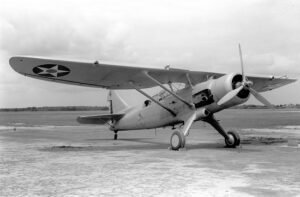
The all-metal Douglas O-46A featured an elliptical wing despite an antiquated parasol layout. (Photo by Emil Strasser courtesy of Gerald Liang)
1933 – The Year of Aviation’s Commitment to Metal
Leaving the gray towers of downtown, south along Lake Michigan during the
summers of 1933 and 1934, a visitor would see a striking cluster of
structures that was Chicago’s "Century of Progress" exposition. It
would attract some 39 million attendees exposing them to a panoply of
wonder and optimism designed to raise hopes and spirits of a populace
burdened by 25 percent unemployment and at the nadir of the great
depression.
As you entered through the avenue of flags, the
giant towers of the sky ride would loom overhead with its doubledecked
gondolas, built in Akron’s Goodyear air dock, shuttling above. Beyond
could be seen soaring modern architecture, air-conditioned halls
displaying new products of industry and concepts for the future. Further
on were large areas for entertainment and representative structures of
foreign culture, then rarely seen by the American mainstream, there was a
pervading sense of old and failing mindsets in the process of change which
would promise better lives. New social programs were already in effect
since President Roosevelt took office in March, together with his
confident assurance that the future should be faced without fear.
(Coincidentally and ironically, Adolf Hitler had assumed leadership in
Germany also in March.)
Until the early 1930s, transportation by auto,
rail and air was essentially in modified boxes with flat-surfaced front
and sides, and an array of juttings that churned the wind. By 1933, cars
were using rounded steel body panels, deep drawn "pontoon"Â fenders,
and raked wind shields and radiator grills. The aeronautical term, "streamlining,"
an early Great War aviation term, was now describing toasters and a
variety of other stationary products.
Since the mid-1920s, a new aesthetic from Europe
known as art moderne (now called art deco) had been influencing
American design in architecture, sculpture, graphics, and furnishings.
Especially of note were automobiles. On view at the Chicago Fair were the
Chrysler and DeSoto Airflows, the Pierce Silver Arrow, the Cadillac "aerodynamic"
V-16, William Stout’s Scarab, and Buckminster Fuller’s Dymaxion. On
rails, the diesel-electric Burlington "Zephyr" and the Union Pacific
"City of Salina" were side-by-side for public inspection and referred
to as "airplanes without wings"Â by the media. Displayed on
pylons in the Travel and Transport hall was a factory fresh United
Airlines Boeing 247 viewed from a walkway over the right wing. Its
aluminum skin was anodized, giving it a gray, rather than silvery, sheen
and introduced the public to a new mode of air travel: the all-metal high
speed airliner.
A further demonstration of progress in aviation
came during July 1933 when an armada of 24 Italian Macchi-Castoldi S-55x
twin-hulled seaplanes arrived over Chicago after a 12,000 mile flight. Led
by General Italo Balbo, he and . . . . .
This article costs $5.00 to download - or it's free for AAHS members.
Already a member? Sign in to download for free.