The First Jumbo Airliner: The Convair XC-99
Gary L. Killion
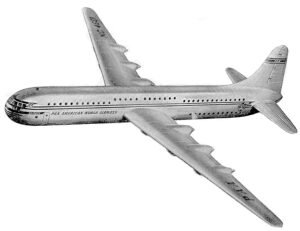
This sketch reflects Pan American’s markings in early 1945 when the 15 airplane order was first announced. Considering the earliest the 37s could have gone into service, the markings would have actually been similar to those first used on Pan American’s Boeing Stratocruisers. Some sketches show it with square windows. (adapted from 1945 Chandler-Evans Corp. advertising)
The First Jumbo Airliner: The Convair XC-99
Long before the term ‘jumbo jet’ was coined, there was an aircraft that certainly deserved the jumbo description. That was Consolidated’s Model 37, a military transport
and airliner derived from the B-36 bomber (Consolidated’s Model 36). One 37 was ordered in late 1942 with the military
model designation XC-99-CO. Throughout its service life, it was the world’s largest regularly and productively flying
aircraft. Fifteen civil 37s were ordered by Pan American
Airways early in 1945 for its postwar fleet. Even though WWII
was not yet won, Pan American optimistically expected to place the aircraft in service by 1950.
The B-36 on which the 37 was based originated before America was actively involved in WWII.
Most of Continental Europe had fallen under Axis aggression by early 1941, and Britain’s fate was still precarious. Japanese aggression had already been raging in Asia for some time. Due to the advent ofairpower, America could no longer be assured that it would be insulated from ongoing war in other parts of the world by the Atlantic and Pacific Oceans. There was growing concern that America might be drawn into war and have to resist aggression from our own shores. Apparently, the attention was focused more on war from across the Atlantic then than from the expanse of the Pacific. The two manufacturers of bombers that were large by prewar standards, Boeing Aircraft Co. and Consolidated Aircraft Corp., were invited to prepare design studies for very long-rangebombers capable of carrying substantial bombloads nonstop
to the Axis in Europe. Boeing received Contract AC-15429 to design and produce the smaller B-29 Super Fortresses, which literally brought WWII to an end. Contract AC-22352was given to Consolidated shortly afterward on November 15, 1941, for two prototypes of what would eventually be thehuge B-36s. Northrop was also a contender; but production contracts for its B-35 flying wing, including 200 to be producedby Martin under license, were later cancelled — due either to its shortcomings or undue political interference depending on one’s point of view.
Apart from their size, B-36s were unique by having six pusher-mounted powerplants — the new and powerful 28-cylinder Pratt & Whitney R-4360 Wasp Major engines with Curtiss propellers. Wasp Major engines were used in a number of other military models and Boeing Stratocruisers, but their engines would differ in detail because of their tractor installations.
America was drawn into WWII less than a month later, not by events in Europe as feared but by the Japanese attack on Pearl Harbor. As a result, America had to declare war on Japan the next day; and Japan’s Axis allies, Germany and Italy, declared war on America a few days later.
Fortunately, we were not forced to fight the Axis from our own shores, so development of the B-36 was initially delayed due to higher priorities. Later, it finally received renewed attention. When first flown on August 18, 1946, the XB-36-CF replaced the Martin Mars flying boat as the largest airplane in the world. The production B-36s that followed would never be used in combat, but would be a very potent deterrent in the then unforeseen Cold War. They were named unofficially, but appropriately, Peacemakers.Referring no doubt to the "speak softly and carry a big stick" quote in 1901 from future President Theodore Roosevelt, they were also described as America’s "Big Stick." Consolidatedt . . .
This article costs $5.00 to download - or it's free for AAHS members.
Already a member? Sign in to download for free.