
The General GA-38 Trimotor, A Lost Opportunity
Gert P.M. Blum
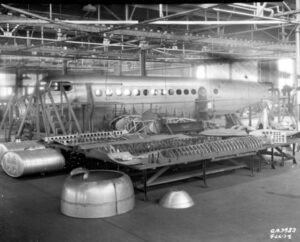
The results of two and a half years of development and construction on the GA-38 shown after the decision to end with it. (Gerald Balzer collection, AAHS archives))
The General GA-38 Trimotor, A Lost Opportunity
When looking back, sometimes you wonder how things got by and what steps or forces in a decision tree caused a failure. The development and construction of the General GA-38 metal airliner was such a process of changing specifications, amending choices, ignoring advice, wishful thinking, missing the steering genius and money available. But of even greater interest is the ‘what if . . .’ question, when things would have gone right with its design. The GA-38 could even have prevented the development of the Douglas DC-2 for Transcontinental & Western Air. Here is its story, to be told after discovery of some microfiche files saved by Lockheed.[1]
Enter General Motors
General Motors Corp. (GMC) got off to a flying restart in aviation when entering a market, abandoned by them in the years after the Great War.[2] They purchased in May 1929[3] 40% of the outstanding capital of the Fokker Aircraft Corporation of America (FACoA) with its plants in both Hasbrouck Heights and nearby Passaic, N.J., as well as in Glen Dale, West Virginia. Within some months GMC also arranged, much to Anthony H.G. Fokker’s annoyance, a license agreement with the German Dornier company to produce their aircraft in the United States.[4] However, it was soon clear that both purchases had taken place near the top of the bull market in aviation and especially Fokker did not promise anymore of the same brilliant future as its past. After a short time, car managers of GMC took over the aviation activities at FACoA and discovered both outdated design/production standards, as well as a lack of promising new developments. And the Dornier license never led to construction of an aircraft in the United States.
To strengthen GMC’s grip on their new business, on May 24, 1930, they incorporated the General Aviation Corporation (GAC) as holding for their aviation interests. One month later, the subsidiary FACoA and the holding GAC exchanged their names and the manufacturing activities were transferred to the ‘new’ FACoA. Then, from June 30 on, GMC was both formally and factually completely in charge of the former Fokker activities, which were guided from the ‘new’ GAC under the presidency of James H. Schoonmaker Jr. Not yet discouraged by their entry into aircraft manufacturing, early in 1931 the takeover of the American Airplane and Engine Corp. (the former Fairchild), was discussed with the Aviation Corporation of Delaware. Its main asset was a clean metal airliner, called Pilgrim Model 150, designed by Col. Virginius E. Clark. Although a deal did not reach completion, discussion on a relationship would be restarted later on.
An addition to GMC’s aviation tree in February 1931 was a small company called Pittsburg Metal Airplane Company[5] accompanied by its designer Herbert von Thaden. This company was subsequently renamed Metalair Corp., and became a subsidiary of GAC on July 7, 1931. Thaden was promoted to chief engineer and general manager of FACoA.[6] This was the same month that Anthony H.G. Fokker resigned his position as director of engineering of FACoA, along with Albert A. Gassner (chief designer). The manufacturing branch was renamed General Aviation Manufacturing Corporation (GAMC).[7] Along with these activities, an airline investment was added when GAC on March 31, 1931, became a 30% shareholder in Western Air Express, thus having an indirect interest into Transcontinental & Western Air (T&WA).
A New Start
The reorganization by GMC was completed in November 1931 with the transfer of all manufacturing activities under the sole GAMC›s umbrella to Dundalk, Maryland. There, the idle plant of Curtiss Caproni was leased with Thaden, with his knowledge of metal aircraft construction, at the helm. Small existing orders for five U.S. Coast Guard Flying Life Boats and 12 O-27 twin-engine observers for the U.S. Army Air Corps were to be fulfilled at Dundalk, as well as a series of modifications to a U.S. Navy fighter, the XFA-1, which ultimately failed to win a production order. Thaden had taken his latest . . .
This article costs $5.00 to download - or it's free for AAHS members.
Already a member? Sign in to download for free.