American Overseas Airline – AOA, 1945-1950
Ed Martin
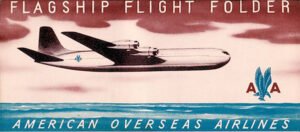
AOA Ticket Jacket. (From the E. Martin collection)
American Overseas Airline – AOA, 1945 – 1950
Pan American Airways (PAA) was unhappy with the transatlantic competition from American Export Airlines (AEA) and contested their operation on at least two occasions, thereby contributing to the birth of American Overseas Airlines. Juan Trippe, president of PAA, had powerful friends in Washington, D.C., and lobbied the Senate Appropriations Committee to reject a mail subsidy to AEA. He later challenged the right of a shipping company, American Export Lines, parent company of AEA, to operate an airline. “The Civil Aeronautics Act of 1938 forbade one common carrier to acquire control of another common carrier in a different area of transportation.” However, the Civil Aeronautics Board (CAB) decided in AEA’s favor as they were starting an airline not acquiring an airline. Pan American Airways later contested that decision in court and won forcing American Export Lines to divest itself of the airline. Juan Trippe considered PAA the “chosen instrument” for U.S. International air travel and aggressively fought all competition.
AEA operated for approximately five years from 1940 to 1945 on north and south transatlantic routes to Europe and Africa. AEA also operated military flights under U.S. government, Air Transport Command (ATC) contracts during WWII, (AAHS Journal Vol 63, No.1, Spring 2018) and was not anxious to see PAA take them over. Pan American and many of the other U.S. airlines had also participated in supporting the war effort with aircraft and crews under ATC contracts, thereby gaining experience in international operations and over-water flying. When the U.S. entered the war Gen. “Hap” Arnold, commander of the U.S. Army Air Force, recruited airline executives to form the ATC appointing American Airlines (AA) president, C.R. Smith (Cyrus Rowlett) as deputy commander where he became a major general over-seeing by war’s end over 200,000 service men and women in the world’s largest airline. ATC served all theatres of war including over the “Hump” in Burma. Juan Trippe was also invited to join ATC but declined being more valuable in support of Pan American Airways. Alexander N. Kemp an insurance executive was appointed to the AA board of directors in Smith’s absence, and Ralph Damon became executive vice president of the airline.
In early 1942 American Airlines fleet was reduced from 79 to 43 by U.S. government acquisition of DC-3s in support of military operations. American Airlines also operated under contract to the ATC and their first North Atlantic survey flight was made on October 8, 1942. December 16, 1942, another American survey flight departed La Guardia across the South Atlantic to India. American was operating approximately 150 transatlantic flights per month for the U.S. military. In the first 13 months of ATC overseas operation American completed more than 1,000 flights. Domestically, despite the reduction in fleet size American still maintained their regular domestic schedule by increased utilization of each aircraft and the dedication of the AA employees.
American’s maintenance base at La Guardia repaired and overhauled the AA airplanes flying for the ATC, and completed special engineering and electronics modifications requested by the military for C-54s, C-46s, C-87 and B-24s. AA at Dallas/Fort Worth played a large part in training commercial flight crews, mechanics, and ground personnel in military operations for ATC and Naval Air Transport Service (NATS).
Meanwhile American Export Airlines was quietly searching for a suitable merger partner realizing that after the war ended thousands of surplus aircraft and qualified pilots would be available following discharge from military service. Douglas . . .
This article costs $5.00 to download - or it's free for AAHS members.
Already a member? Sign in to download for free.