
The Search for Historic Truth; The Search for Lt. Eugene M Bardley’s Crash Site
Thomas C. Palshaw
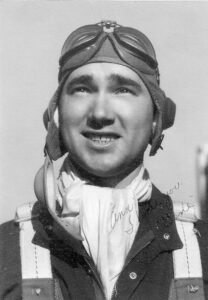
Lt. Eugene M. Bradley. (Photo courtesy of Ann Bradley Martens)
The Search for Historic Truth; The Search for Lt. Eugene M. Bradley$rsquo;s Crash Site
The New England Air Museum (NEAM) published Bradley
Field, the First 25 Years in 1998, a history book of
Connecticut’s premier international airport. This book
was the culmination of four years of research. Civilian and
military participants of the period were interviewed. Local, state,
and national records were reviewed. State officials, media
archives and libraries were visited. Many questions were raised
and answered. Though there were many diverse opinions on the
answer, one question remained unanswered.
It began as a casual question; “Where had Lt. Eugene M.
Bradley crashed?” The more this question was asked, the more
diverse the details became. This question was not the primary
focus of the book, so we did not press for the correct and
complete answer.
We had found a photograph in the NEAM newsletter that
was marked as the Bradley crash. We used it without question
only to find the original photo years later. Photos were
published in the October 2003 issue of Air Classics showing
other views of the same crash. We now had evidence that the
photo was not of the Bradley crash. The new photos show no
leaves on the trees, bystanders were wearing overcoats, and the
hazy white material on the ground was snow. Lt. Bradley had
crashed on August 21, 1941.
Was it important to find the answer to this question? If one
looks back to the prevailing conditions in 1941, the impact the
airfield had on the local communities, the state, and to the
sacrifices made by the WWII generation you can only answer
in the affirmative. Bradley International Airport not only serves
as Connecticut’s largest and most active transportation center,
it is a living memorial to Lt. Bradley and to all those who have
served or sacrificed so that we may enjoy the freedom we have.
This was not the first attempt to find the crash site. Others
had tried before. This report summarizes our effort to answer
this question. An archive of supporting materials collected
during this research will be maintained at the NEAM for future
researchers to review.
Many people contributed to the research. We had
unwavering support from state officials, the DOT, the airport
administration, local communities and corporations, the military
and federal agencies. A thank you to all of you for opening
doors, providing data, supplying expertise and giving guidance.
THE WINDSOR LOCKS AIRBASE
Prelude to War
As Connecticut struggled with the economic consequences
of the Great Depression, events in Europe and Asia signaled new
dangers abroad. By the spring of 1936, Adolph Hitler had taken
control of the Rhineland and created the Rome-Berlin axis with
Italian dictator Benito Mussolini. That summer, civil war broke
out in Spain with the forces of Francisco Franco fighting the
Spanish Loyalists who were being aided by both the Italians and
Germans.
In the fall of 1937, Japan renewed its intervention activities
in China. Hitler seized Austria in March of 1938 and followed
up with taking Czechoslovakia in 1939. In August of 1939, Hitler signed a Non-Aggression Pact with the Russians in
preparation for his September 1, 1939, invasion of Poland. Two
days following this invasion, England and France declared war
on Germany.
With the outbreak of war in Europe, orders for military
goods and supplies soon reinvigorated the aviation and
munitions industries. These orders resulted in a mad expansion
of the work force and plant capacity reminiscent of the boom
years associated with the First World War. The aircraft industry,
already established in the Hartford area, benefited greatly from
these contracts. In East Hartford, United Aircraft Corporation’s
Pratt and Whitney division grew from 3,000 employees to over
20,000 in 30 months. Other defense-related industries such as
Hamilton Propellers and Electric Boat similarly prospered.
Locating an Air Base in Windsor Locks.
The primary airfield in Connecticut was Brainard Field in
Hartford. After the opening of Brainard Field (named for
Newton C. Brainard, mayor of Hartford) in October 1922,
efforts were soon launched to secure the new military air
service unit for Connecticut. At the time, Rhode Island and
Massachusetts were also vying to secure the military air service
unit.
The Army also evaluated Bowles/Agawam Airport (then
being used as a racetrack) and similarly rejected it for military
use. During the course of conducting an aerial survey, the Army
noted the possibilities presented in the Windsor Locks area.
A preliminary survey was conducted in November of 1940
and in January, 1941. Governor Hurley agreed that the project . . .
This article costs $5.00 to download - or it's free for AAHS members.
Already a member? Sign in to download for free.