America’s Local Service Airlines, Part III: Frontier, Lake Central, Mohawk & North Central
David H. Stringer
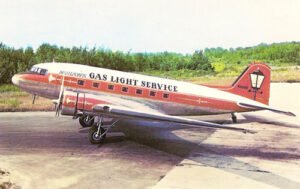
Mohawk began phasing out their DC-3 fleet in the late 1950s, but retained a few specially decked out "Gas Light" Gay Nineties aircraft. (From the author’s collection)
America’s Local Service Airlines, Part III: Frontier, Lake Central, Mohawk & North Central
FRONTIER AIRLINES
Financing was difficult for many of the feeder airlines just getting off the ground in the late 1940s. The CAB’s feeder Certificates of Public Convenience and Necessity were temporary, all of them valid for just three years to begin with. This short-term guarantee did not inspire a willingness on the part of banks or private investors to infuse funds into the companies’ coffers. The only guaranteed income was the compensation paid by the government for operating the services, offered in the form of air mail subsidies.
To save money, the two feeders operating in the Rocky Mountain States area, Monarch Airlines and Challenger Airlines, prudently took it upon themselves to share maintenance, sales, and other departmental tasks from their individual headquarters
in Denver. The next step seemed natural, to enter into a merger agreement.
Monarch was the brainchild of Ray Wilson, who had received his feeder certificate from the CAB under the moniker of Ray Wilson, Inc. After the certificate award was announced, Ray Wilson, Inc. changed its corporate title to Monarch Airlines. Of the carriers created specifically for the purpose of starting a certificated feeder operation, Monarch held the distinction of being the first in the nation to get off the ground.
Service was inaugurated on November 27, 1946, (another airline, Essair, which later became Pioneer Air Lines, had started service in 1945 with a CAB-issued feeder certificate, but that company was already in business at the time of its award and had previously operated as an intra-state carrier). Monarch operated in the area from Denver and Salt Lake City stretching south through Utah and Colorado into New Mexico with a terminus at Albuquerque.
Challenger’s history was a little more convoluted. Summit Airways, organized by Charles Hirsig, won the CAB certificate for feeder service stretching north from Salt Lake City and Denver, via intermediate points in Colorado and Wyoming, to the terminal point of Billings, Montana. Hirsig was killed in an aircraft accident before the certificate was issued in the Rocky Mountain States Area Case. Summit’s ownership passed to Fred Manning of Denver.
In the same Rocky Mountain States Case, an airline operating Beechcraft D-18s in intra-state service within Utah had been denied a feeder certificate. That company, originally organized as Midwest Airways, was called Challenger Airlines, . . .
This article costs $5.00 to download - or it's free for AAHS members.
Already a member? Sign in to download for free.