
Amelia Earhart and Fred Noonan Flight to Oblivion
H.N. “Dusty" Rhodes
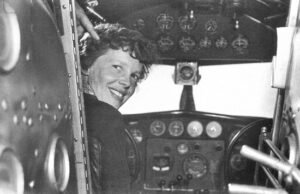
Amelia Earhart in the left seat of her Lockheed 10E. (Photo by A.L. Bresnik from the author’s collection)ÂÂ
Amelia Earhart and Fred Noonan Flight to Oblivion
Did she over-rule her expert navigator? Did she think she was a "natural direction finder"Â capable of directing her Lockheed 10E using a talent on loan from God? While flying from South America to Africa she must have thought she had that talent! She turned north against her navigator’s instructions and had to make an unplanned landing at a strange African airfield!
If she over-ruled Noonan on that Atlantic Ocean hop from Natal, Brazil to St. Louis, Senegal, (she planned to land at Dakar, Senegal), why couldn’t she again over-rule Noonan as they approached Howland Island? Imagine notes passed between the two that read as follows:
"Come left to 67 degrees. Hold that course for 48 minutes."Â
"No! I’m going straight in. I think I see the Island."Â
"No! I’m telling you to turn left to 67 degrees. We’re still one hundred miles out."Â
If we knew that Earhart had again overruled Noonan, we might know why their flight ended in disaster. However, their disappearance remains a mystery after 70 years.
THE HOWLAND ISLAND APPROACH
Fred Noonan was an accomplished celestial navigator. He could advance a "line of position"Â based on estimated latitude and a single celestial shot or he could use the more complicated and time consuming triangulation method wherein two or three heavenly bodies were used for reference. How, then could he have missed Howland Island? A close study of available information can refine speculation on what likely took place in the Howland Island vicinity in early July 1937. Radio transmissions from Earhart indicated that the weather was rainy and cloudy over mid portions of their course. The USS Ontario, on station halfway between Lae, New Guinea, and Howland Island also reported low ceilings and a wind out of the east-northeast. Many of the early long distance flyers
. . . . . .
This article costs $5.00 to download - or it's free for AAHS members.
Already a member? Sign in to download for free.