End of an Era, the Last Reno Air Races
Paul Walter & Ann-Marie Loos
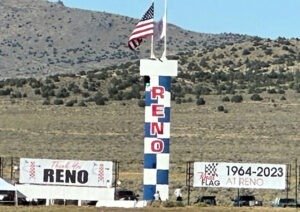
The signs say it all. Reno 1964 to 2023. It may be awhile before a new location might be found to hold unlimited air racing. (Photo by Paul Walter)
End of an Era, the Last Reno Air Races
There once as a land where brave skilled pilots and the smell of 115/145 Avgas fuel and the dream of victory prevailed – it was called Reno. Here is where the fastest motor sport in the world took its last bow. Where a small group of genius aviators and dreamers, with limited finances, made lower drag airframes and pushed for more horsepower in their piston engines in the quest for faster airspeed. Here was the last ever to be seen of the "Knights of the Air," and their stories of how they won by pushing their craft far beyond what others accepted as limits. Look for it only in books, for it soon will be no more than a dream remembered. A time and place where a unique group of engineers, mechanics, pilots, and visionaries gathered every September to push the envelope. They are gone – gone with the wind.
The first airplane race was in Reims, France in 1909, just six years after the Wright Brothers first flew. Although Frenchman Louis Bleriot was favored, USA’s underdog, Glenn Curtiss, won. Eventually the races became dominated by countries demonstrating their fastest new military pursuits. That changed at the Cleveland National Air Races of 1929. The Thompson race was the unlimited closed pylon race. The well-funded military pursuits were embarrassed when a small civilian company&rquo;s low wing Travel Air Mystery Ship easily beat them all, turning laps at just under 200 mph. Though the military tried for the next several years, civilian innovations just three years later had Jimmy Doolittle winning at over 250 mph in the Gee Bee R1, (and earning the winner’s purse of $4,500 [equivalent to $98,800 in 2024 dollars]. The golden age of air racing ended when colorful Roscoe Turner (who often flew cross country with his pet lion, Gilmore) won Cleveland at just under 300 mph. As most of you know a farm boy from Oshkosh Wisconsin, named Sylvester "Steve" Wittman, competed with old WWI military engines and his homebuilt, amazingly low-drag airframes. Wittman often led the race, but never won. However, Steve almost always finished in the money. 1939 would be the last Cleveland Air Races until after the war.
When the Cleveland Air Races returned in 1946, North American Aviation, along with many other companies had made huge progress in top speed. With advance trainers and fighters selling at scrap prices, many pilots, male and female, could not wait to modify them to race in the cross-country Bendix race and the closed-course pylon Thompson race. The Thompson would see P-39s and P-63s Bell Cobras (one was entered by Steve Wittman), Corsairs and Super Corsairs, P-38s, Curtiss YP-60 and XP-40 and several P-51 Mustangs. Many rare WWII fighters that survive today, were saved from the scrappers to be raced.
For the women’s race, the Halei Race (named after a department store in Cleveland) fielded only North American AT-6 Texans and SNJs. It was dominated by former WASPs pilots. By 1948, the women were turning around the course in their T-6s at over 234 mph! A respectable Reno Gold T-6 speed today. But there is a catch, their T-6s had large blowers installed on the motor, canopies removed, and wings modified to make that speed. In 1949 the rules changed to compete the T-6 racers had to have "stock motors" and nonclipped wings. These requirements are still used by the T-6 class today.
However, in September 1946, the focus at Cleveland was on the Unlimited R (reciprocating piston engine) class. Speculation and branch service pride drove discussion of . . .
This article costs $2.50 to download - or it's free for AAHS members.
Already a member? Sign in to download for free.