
Jules Verne Inspired the V-2 and U.S. Moon Rocket
Douglas G. Culy
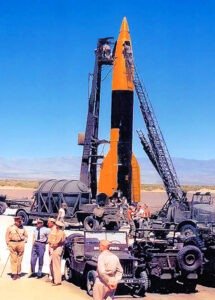
V-2 being prespared for launch at White Sands with dignitaries in foreground. (USAF photo)
Jules Verne Inspired the V-2 and U.S. Moon Rocket
The story of the V-2 rocket stretches behind and beyond its sneak attacks on London, encompassing development by space-flight dreamers, production by concentration-camp inmates, attacks from shifting hard-to-find sites, further development in Russia and the U.S., and motivating rockets to outer space. Building it, started before German leader Adolph Hitler’s arrival; then it was ignored, later cancelled, and finally embraced by him; leading to Russia, the U.S. and China reaching space and the moon.
The inventors of the V-2 rocket, probably the 20th century’s biggest aviation surprise, were inspired by early science fiction. France’s Jules Verne (1828-1905), wrote an imaginative story and its sequel in 1865 and 1870: "From the Earth to the Moon" and "Around the Moon," that created space flight enthusiasts worldwide. He was not the first, much earlier the Greek Lucian of Samosata (120-180 A.D.) originally brought the subject up. Englishman H.G. Wells’ "War of the Worlds" in 1897, was almost as exciting. Then, in Russia, Europe and the U.S., activity intensified on imagining, designing and building a rocket to get people to the Moon or Mars. At that time, manned rocket capabilities did not extend beyond the imagination of Jules Verne. This was in spite of his first mode of travel to space being in a cannon shell, using rockets only for directional control. Verne’s books continued to be published long after his death, and he is the second most translated author in the world. He wrote five space-flight novels and more than 50 exotic travel novels. At least a dozen movies were made from Verne books.
Seventy years after Verne, the development of the V-2 rocket Vengeance weapon in Peenemunde, Germany, was done by people who mostly wanted nothing more than to follow Jules Verne to the Moon. This was amply reflected by their actions over many years. V-2 development, production and operation had different leaders, organizations and locations. This story focuses on how each came about. The V-2 was a tremendous technical achievement, with such advanced capability that few could imagine or anticipate its existence. But it was a poor use of resources. Its story traces from Russia to France to the U.S. to Germany, and eventually to the Moon with the U.S. and Russia (Russia getting there first).1 The differences in technology and motivation resident in these countries made for an uneven pathway.
In Europe, Verne’s followers were playing with powder rockets and dreaming of going to space. They were NOT dreaming of rockets as weapons, although such had been their use in Asia and Europe since the early 1200s. Early on, there were four noted space and rocket pioneers: the Russian teacher Konstantin Tsiolkovsky, American physicist Robert Goddard, French space-scientist Robert Esnault-Pelterie, and German-Rumanian writer and rocket enthusiast Herman Oberth.
In Russia, schoolmaster Konstantin Tsiolkovsky in 1878-79 had read Verne, analyzed various aspects of space flight, the control of rockets and their engines, use of dirigibles and other possible ways to get into orbit and travel in space. He also published interplanetary travel stories that inspired his fellow Russians, who built the rockets that he only imagined. Those first Russian liquid-fuel designs were imagined in 1898, and flown in summer 1932 at low thrusts, but halted during Stalin pogroms. Tsiolkovsky died in 1935.
In 1912 Esnault-Pelteri gave popular lectures in Paris on spaceflight with solid- and liquid-fueled rockets based on studies he began around 1907. That year, the SS Titanic used solid-rocket flares to signal its distress after hitting the iceberg and needing rescue. Esnault-Pelterie in the 1930s published his book "L’Astronautique" on space flight, and lived to 1957, knowing spaceflight was finally happening.
In 1909, Robert Goddard in Massachusetts was also inspired by Verne for space flight, and started with powder rockets in 1915 because they were much simpler to construct. Goddard soon found they had limited range because powder fuel was mostly binder that did not burn with much energy, while liquid fuels burned with significantly more effectiveness in producing thrust. In 1917-18 he worked for the Army, and proposed liquid rockets, which they did not respond to. Much later, Goddard made the world’s first liquid-fueled rocket flight on March 16, 1926. He eventually filed 214 liquid-rocket patents. Most interestingly, some of Goddard’s rocket flights were done at . . .
This article costs $5.00 to download - or it's free for AAHS members.
Already a member? Sign in to download for free.