
What Happened to the Wright Brothers After 1903 and 1908?
F. E. C. Culick
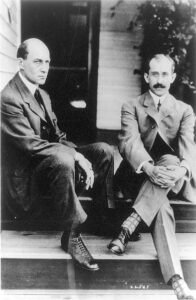
Orville and Wilbur Wright on the steps of their home. (Photo from the Library of Congress)
What Happened to the Wright Brothers After 1903 and 1908?
The achievement of the Wright brothers on the windy cold beach of Kitty Hawk on December 17, 1903, is well-known and not in doubt. They were truly first to fly an a powered vehicle under control of an on-board pilot. Wilbur, older than Orville by four years, had failed to fly in a weak wind three days earlier. (Who was first to try was decided by a coin toss!) Nearby at the right wingtip Wilbur is anxiously watching the “First Flight” 117 years ago. His brother Orville was on board for the picture familiar to anyone who has even a passing interest in aviation history.
Interpretation of the photograph of the first piloted flight, the most famous picture of the 20th century (according to Life magazine’s assessment at the close of the century), is far more complicated and has a much more poignant interpretation than commonly believed. The main purpose of this paper is to explore and to explain a few of the many reasons that the man who virtually alone should be recognized as the inventor of the airplane is Wilbur. His accomplishments deserve everyone’s praise and should not be diminished by the almost universal practice that gives equal status to the two brothers as co-inventors. The man who will always be known (and celebrated) as the first to fly a powered aircraft was certainly not the man who had the ideas that made that first flight possible. It was truly a magnificent event caught in an unforgettable picture, of an historical occasion. It is important that beliefs based on, and related to, that picture be soundly established.
Introduction
It is an accident that the man who made the picture possible in 1903 has not received the full recognition that is really his. Although Orville arranged the photographic equipment, and was apparently responsible for the many photographs taken of Wilbur and the brothers’ working together, it was Wilbur who had complete responsibility for the formulation and success of the project until his death in 1912 at the age of 45. His brother died in 1948, aged 77, having never given a true and complete account of the process leading to the brothers’ success.
It was an accident of a coin throw that as far as most people are aware, the case that the two brothers share equally the responsibility for inventing the airplane, one of a small number of truly great inventions by humans. My reasoning based on the available evidence is that Wilbur stands alone as the inventor. His brother was a valuable help, and learned to fly first in 1902 with Wilbur’s direction and only after Wilbur decided his own flying indicated that the glider was safe for Orville to try.
While this story has often been told by many people, in their own ways, this paper examines the events from a different perspective based on material that was first became publicly available in 1953 when Marvin McFarland collected and published the Wright brothers’ papers and diaries. The very best account by a historian is found in The Bishop’s Boys (1989) written by Tom Crouch. Chapters 12 and 13 in this work come closer than any other writings in support the views presented here. [1]
The main purpose here is to cover my interpretation of the Wright brothers’ invention, namely that Wilbur had virtually all the ideas from the project’s inception in 1898 and was ‘in charge’ until his early death of typhoid in 1912. Every effort has been made to avoid unfounded speculations, for everything set forth is founded on the Wrights’ own writings. A few guesses based on general knowledge and personal understanding of subjects will be offered, and when doing so we have tried to carefully distinguish between these interpretations and established historical facts.
Because we are dealing with events that occurred before 1912, a certain amount of guessing is unavoidable. Also, because of the breadth of the story, covering some parts can only be cursorily addressed, which is regrettable but necessary in order to focus on the primary theme.
The relationship between the brothers in their program of inventing the airplane, especially who contributed what, seems to have been examined previously in depth by two authors, Crouch and James Tobin, in his carefully researched and very well written book, To Conquer the Air.[2] With a view to determining just who contributed what in the important period, 1899 to 1905, and subsequently to 1908 when their invention . . .
This article costs $5.00 to download - or it's free for AAHS members.
Already a member? Sign in to download for free.