The History of Republic Airport
Robert G. Waldvogel
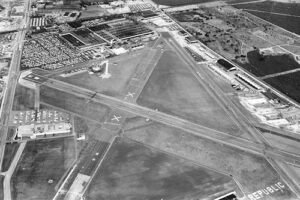
Republic Aviation’s factory buildings are toward the top of this aerial photographs of Republic Airfield taken in the early 1960s. (Courtesy of Republic Aviation Archives via Long Island Republic Airport Historical Society)
The History of Republic Airport
Located in Farmingdale in the center of Long Island, N.Y., Republic Airport is a historically significant airfield to the both the region and the world, having played a major part in the development of both military and civilian aircraft. Before its present form as a general use airfield, it was the site of aircraft manufacturers that were a major part of aircraft history for the area as well as the world.
“The Industrial Revolution and airplane manufacture came to Farmingdale during WWI when Lawrence Sperry and Sydney Breese established their pioneering factories in the community,” wrote Ken Neubeck and Leroy E. Douglas in their book, Airplane Manufacturing in Farmingdale (Arcadia Publishing, 2016, p. 9). “They were drawn by the presence of two branches of the Long Island Railroad, … the nearby Route 24, which brought auto and truck traffic to and from the Fifty-Ninth Street Bridge in Manhattan; the level outwash plain, which provided land for flying fields and the proximity to skilled workers…”
The area’s first aviation roots, however, were planted as far back as 1917. The Lawrence Sperry Airplane Co., incorporated that year with $50,000 of capital and located on Rose and Richard streets in the village of Farmingdale, produced its first aircraft in the form of the Messenger.
Designed by Alfred Verville of the U.S. Army’s Engineering Division at McCook Field, the minuscule, 17.9-foot-long, all-wood biplane was intended for “aerial motorcycle” missions, alighting in small clearings to drop off and pick-up messages from field commanders, thus earning its name. Powered by a 60-hp Lawrence L-4 radial, the 862-pound aircraft sported a 20-foot wingspan and could operate within a 45- to 97-mph airspeed envelope. Subsequently provisioned with an in-flight hook, the Messenger was first dropped from Army blimp TC-7 on October 23, 1924, and first re-connected to blimp TC-3 two months later, on December 12. Eventually, Sperry would construct 42 airplanes, including prototypes, which were track-launched as “aerial torpedoes” in order to test various airfoils, cambers, and tapers before the definitive configuration was chosen.
The succeeding Verville-Sperry R-3 Racer, a low-wing, aerodynamically sleek monoplane built at the Sperry Rose Street factory, introduced the first retractable undercarriage. Completed in 1921, the same year that the company relocated to the 10-acre flying field on Motor Avenue in South Farmingdale, the aircraft, powered by a 350-hp Wright H-2 engine, could achieve 216 mph.
Farmingdale’s aviation roots were equally cultivated by Sydney Breese, whose Breese Aircraft Co., located on Eastern Parkway, designed the Penguin. Resembling the Bleriot XI, the mid-wing airplane, powered by a two-cylinder, 28-hp, roughly-running Lawrence engine, was a non-flying, preflight . . .
This article costs $5.00 to download - or it's free for AAHS members.
Already a member? Sign in to download for free.