
Sentimental Journey, The Air Fields of the Sixth Air Force; Rio Hato
Dan Hagedorn
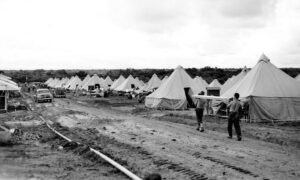
“Home” of the 9th Bomb Group at Rio Hato from November 1940 until they moved, to great rejoicing, to the brand-new barracks at Howard Field, CZ, starting after the outbreak of war. Note the water pipe lying atop the “main drag” at lower left. (Richard W. Spencer)
Sentimental Journey, The Air Fields of the Sixth Air Force; Rio Hato
When I arrived at Howard AFB, Canal Zone (CZ), in a torrential rain aboard a USAF Douglas C-118 in 1965 – 20 years to the month since VJ Day – and checked in with the Army liaison at the terminal, the very first question the duty driver asked me was “Are ya’ headed to Rio Hata?” I learned very quickly that, although it was properly called “Rio Hato,” U.S. service personnel in the Canal Zone referred to this mysterious place invariably as “Rio Hata.”
Although I subsequently visited Rio Hato on many occasions by air and did a bit of exploring, thereby demystifying the destination, I will never forget the first expedition to the exercise location there as a member of the headquarters staff of the 193rd Infantry Brigade, based at Fort Kobbe, CZ. We wound our way some 80 miles west via convoy over the WWII-built Pan American (sometimes cited as Inter-American) Highway through terrain that ranged from tropical jungle to twisting mountainous precipices to semi-flat terrain that seemed very much like parts of West Texas. Upon arrival in the lead vehicle with Maj. James E. Bopp, the Brigade’s adjutant, I was struck by the fact that the highway neatly bisected the main runway of this legendary airbase, a fact which resonated through my subsequent historical investigations. As I drove slowly across the breadth of the primary runway that hot afternoon, I had no idea of the history of the base, or the role it played during WWII.
Early Beginnings
The site of what became the Rio Hato aerodrome lies some 55 to 60 air miles (about 80 by land) southwest of what was Albrook Field (Balboa), CZ. Located on one of the few plains in the Republic and relatively free of the pervasive jungle often associated with this area of the tropics, one of Rio Hato’s primary allures has been its nearly year-round flying weather, which for the region could be described as exceptionally good. The subsequent “discovery” of this area contributed greatly to the safety of flights to the Canal Zone. Its almost sea-level, flat approaches and prevailing visual-flight-rule (VFR) weather conditions prevailed almost 100% of the time – even during Panama’s notorious rainy season – a quality in the area beyond value for countless airmen. As events unfolded, by 1945, more than 40 auxiliary aerodromes were established throughout Panama and the region to aid in the defense of the vital Canal; however, Rio Hato was the very first outside the Canal Zone itself to gain Army attention.
As early as 1916, the U.S. Army’s Panama Canal Department operated a disciplinary camp in the Rio Hato area, the first known instance of military interest in the area. As the Inter-American Highway was still more than 25 years in the future, access must have been torturous and via surface vehicle up the Pacific coast from the Canal. The majority of the land in the area was actually owned by a Danish citizen, Peter Hans Kierluff, doing local business as the Cia. Agricola La Venta, S.A. When he realized that his inability to transport produce to the closest market, Panama City, limited his dream of creating an agricultural empire in the area, Kierluff established a primitive airstrip on his land as early as 1923. Although the area is known to have been used as an artillery range as early as 1924, Kierloff, being something of an entrepreneur, recognized in short order that the destination was nearly ideal for U.S. Army Air Service and U.S. Navy pilots on local training flights from France Field and the Coco Solo Naval Air Station on the Atlantic end of the Canal. Furthermore, Kierluff correctly anticipated that cold, . . .
This article costs $5.00 to download - or it's free for AAHS members.
Already a member? Sign in to download for free.