
Northrop F-20 Tigershark, Gone but not Forgotten
Sidney M Yahn
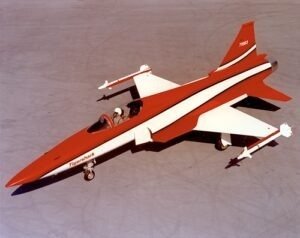
Mock-up of the Northrop F-20 Tigershark
Northrop F-20 Tigershark, Gone but not Forgotten
It was December 1986 when one of the most intensive and competitive U.S. aircraft marketing efforts conducted in the United States was terminated. After spending $1.8 billion of company funds, and with no firm sales in sight, the Northrop Corp. made the tough decision to cut the umbilical cord of their F-20 Tigershark Program.
For those interested, Chapter 10 of Erik Simonsen’s book titled Project Terminated is an excellent condensed review of the F-20 Program. Even so, this, or any other existing publication, is unlikely to contain all the twists and turns involved in this intriguing Northrop venture.
From 1980 to 1988, the author was head of Northrop’s Taipei, Taiwan, office. It is from this perspective that this article is based. Initially, Taiwan was the primary F-20 marketing target. The intent of this article is to deal only with those matters that had an impact on Northrop/Republic of China (ROC) F-20 activities.
It should be remembered that, at that time, both the T-38 Talon and F-5E/F Freedom Fighter were very successful Northrop programs. It is common practice, however, that aircraft manufacturers continually search for ways to remain competitive by improving their products. For some time, Northrop had been evaluating a number of engines in an effort to enhance the F-5E. As a result of this effort, the General Electric F-404 engine was selected (the same engine that powers the F-18 Hornet). It took considerable time, for those responsible, to determine if the aircraft would be a single-engine or twinengine fighter. At this point, few people realized what an important role the element of time would play during various phases of the F-20 program.
In 1978, the Republic of China Air Force (ROCAF) contacted the United States Air Force requesting performance data for an F-5E carrying an AIM-7 Sparrow missile. The AIM-7 Sparrow is a radar homing air-to-air missile produced by the Raytheon Company. The missile itself is quite large, being 12 feet long and weighing approximately 500 pounds. It is an
all-weather weapon system with a solid-propellant motor that could be used against aircraft or ships. The USAF contacted Northrop to acquire the data that ROCAF requested.
During the wind-down period of the Vietnam conflict, the U.S. and ROC governments agreed to provide the Vietnam Air Force (VAF) with a number of ROCAF F-5 aircraft. In turn, the U.S. would temporarily supplement the ROCAF’s air defense . . .
This article costs $5.00 to download - or it's free for AAHS members.
Already a member? Sign in to download for free.