
Auxiliary Exhaust Ports in Early Aircraft Engines
Jim Cowart, US Naval Academy
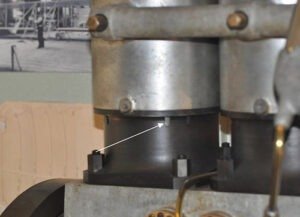
A Wright Vertical-4 engine on display at the National Air and Space Museum, Washington, D.C. (Photo taken by author) Auxiliary exhaust ports can be seen at the base of the engine cylinder, just below the aluminum (silver) water cooling jacket. (Photo from the author’s collection)
Exhaust Ports in Early Aircraft Engines
A careful
look at early Wright brothers and Glenn
Curtiss engines reveals a fascinating design
feature. Small holes can be seen at the base
of their engine cylinders. The Wright
brothers used circular (and later rectangular)
"holes,"Â also referred to as "auxiliary
exhaust ports,"Â in their 1904 Engine No. 3 as
well as their Vertical-4 engines. Glenn
Curtiss also used auxiliary exhaust ports in
some of his 2, 4 and 8-cylinder aero engines.
A few others, including engines from the Kemp
Machine Works, Bates Engineering Co., as well
as the famous Anzani engine in the Bleriot IX
also used this engine design feature. These
auxiliary exhaust ports were through holes at
the base of the individual cylinders that
exposed the inside of the engine cylinder to
the atmosphere when the piston was near
the bottom of its stroke. Since these engines
operated under the four-stroke cycle
principle, these holes, at first, seem rather
odd to the modern observer. Who did this and
what was
the purpose of these holes in the engine?
A schematic of
auxiliary exhaust ports is shown in Figure 1.
This engine schematic represents the F-head
type used by Glenn Curtiss in his early engine
designs. Near the base of the engine cylinder
can be seen a set of three holes that would
exhaust to the atmosphere at the end of the
combustion-expansion stroke (left side). These
were known during the late 19th century and
first decade of the 20th century as "Auxiliary
Exhaust Ports."Â The right side schematic shows
the conventional exhaust stroke with exhaust
leaving the engine’s cylinder via the exhaust
valve.
What was the origin
of this design feature? This article will
briefly explore the basis for these ports
starting with steam engines, two-stroke
engines, stationary gas engines and early
motorcycle and automotive engines that likely
led to the introduction of this design feature
by some early aviation engine manufacturers.
Some notable early aviation engines that used
this concept will be explored in this article.
Then, as the Great War arrived, this aviation
engine technology faded away.
Steam Engines
During the later decades of
the 19th century auxiliary exhaust ports were
present in both stationary and railway steam
engines. In general, these auxiliary exhaust
ports were part of the valve box that is
connected to the working steam pistoncylinder.
At least one design, however, used an
auxiliary exhaust port that was directly
connected to each end of the working steam
cylinder (1). The purpose of these "Ëœextra’
exhaust paths was to reduce the steam pressure
in the working cylinder down . . .
This article costs $5.00 to download - or it's free for AAHS members.
Already a member? Sign in to download for free.