Homage to the Hustler: Reflections on Flying the Convair B-58
Tony Fairbairn
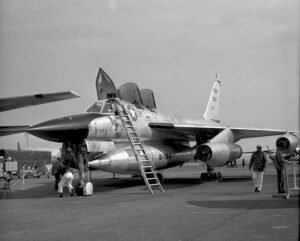
Hustler 59-2451, The Firefly, in which Ray Wagener’s crew broke the New York-Paris record, pictured at the Paris Air Show in 1961. (Photo from the AAHS collection, AAHS-781)
Homage
to the Hustler:
Reflections on Flying the Convair B-58
Lt. Col.s "ËœBJ’
Brown, Darrell Schmidt and Ray Wagener, USAF (Ret.), tell Tony Fairbairn
what it was like to fly the Convair B-58 Hustler.
There is still a mystique about the Hustler that astounds me. Back when we
were flying it, if we landed at another USAF base, folks would want to
come out and see it, feel it, touch it and talk with us about it."
"Just sitting parked on the tarmac it looked as though it was going
supersonic." These tributes from ex-Hustler crewmen are typical of
the admiration in which the B-58 was, and still is, held. With its
stunningly futuristic good looks and Mach 2 performance it is hard to
believe that 40 years have elapsed since the type flew into retirement
after a relatively brief career (1960-70) with the 43rd and 305th Bomb
Wings of the USAF’s Strategic Air Command (SAC). It had a crew of three
– pilot, navigator/bombardier (nav/bomb) and defensive systems operator
(DSO), seated in novel tandem ejection capsules. I invited one of each
(from different crews) to give me their impressions of life with the world’s
first supersonic bomber.
Darrell
Schmidt – Pilot
Schmidt joined the USAF in 1951 via the Aviation Cadet Program, gaining
his wings and 2nd Lieutenant bars in 1955. Training on the Piper Cub,
North American T-6 Texan, T-28 Trojan and Lockheed T-33, his first
productive assignment was instructing on T-33s. He then moved on
successively to the B-47 Stratojet and B-52H Stratofortress as aircraft
commander, instructor and evaluator. He takes up his story:
"In 1966 I received orders to go to Little Rock AFB, Ark., for an
evaluation for entry to training in the B-58 Hustler. The evaluation
consisted primarily of proving I could fit into the ejection capsule,
followed by an oral evaluation plus a review of my previous training
records to ensure I was sufficiently competent to command the single-pilot
Mach 2 aircraft, with the emphasis on flight in instrument conditions.
"Part of the "Ëœlead-in’ training included time at Perrin AFB,
Tex., for instrument training in the T-33. This also
. . .
This article costs $5.00 to download - or it's free for AAHS members.
Already a member? Sign in to download for free.