
The Aero-Engine that won WWII in the Pacific
Dr. William Wolf
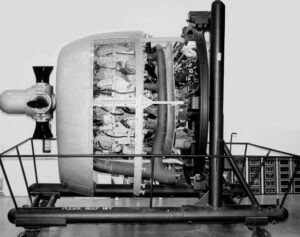
When Wright engineers began R-3350 development in January 1936 they incorporated as many of the established Cyclone engine attributes as possible into the new engine following the design and construction details of their successful R-2600. The R-3350 was an air-cooled, duplex engine that had 18 cylinders with two radial rings of nine cylinders positioned around the crankshaft. (Author/Pima ASM)
The Aero-Engine that
Won World War II in the Pacific
The
success of the B-29 program and ultimately the conduct of the Pacific war
hinged on the timely development, subsequent dependability, and mass
production of the 2,200-hp Wright R-3350 Cyclone engine designed by
the Wright Aeronautical Division of the Curtiss-Wright Company of
Paterson, N.J.
Wright R-1820 and R-2600 Cyclone
Engines
At
a time when Pratt & Whitney dominated American aircraft engine
manufacturing with its Wasp and Hornet engine series, Wright
initiated its Cyclone engine series in 1923 with a Navy contract
for two of the new radial engines. In 1929 Wright merged with Curtiss and
by 1932 the two engineering departments collaborated to produce the
outstanding 9-cylinder 1,000-hp Cyclone F designated the R-1820
that were to power the Douglas airliners and the B-17 bomber. Work on a
14-cylinder engine began in November 1935 and use the hard-learned lessons
in the development of the R-1820. The 14-cylinder 1,600-hp Wright R-2600 Cyclone
was the company’s first successful two-row air-cooled radial engine.
It was used to power the Boeing 314 Clippers and would become a major
wartime aircraft engine used in the AAF B-25 and A-20 medium bombers and
the Navy’s TBM/TBF and SB2C carrier bombers.
Wright R-3350 Cyclone Development
A
larger engine was needed to power the B-29 and the Wright engineering
department’s developmental objective for the R-3350 was to produce one
horsepower for every pound of weight. Wright engineers mounted two
9-cylinder Cyclone engines together at a 90-degree angle from each
other to form a "V"Â with its open ends facing toward the line of
flight to yield a displacement of 3,640 cubic inches. Power from each
engine was transferred through a common gearbox that combined the power of
the two engines and directed it into the propeller main shaft. While
single Cyclone R-1820s had flown reliably over millions of airline
and military miles the new combined engine presented Wright engineers with
a number of problems. The gearbox added weight and there was two of every
engine accessory: two carburetors, two superchargers, two air scoops, and
dual fuel and oil lines. Although the dual engine was the standard 55
inches in diameter its cowl needed to be much wider to facilitate cooling.
Wright
engineers soon realized that the inherent problems of a combination engine
were significant and went back to the drawing boards to design an entirely
new 18-cylinder 3,350-hp flat engine that would become the company’s
financial backbone until well after the end of the war. Initially, Wright
didn’t have enough engineers to devote to the R-3350 project as they
concentrated on the R-1820 and its employment in the prewar DC-2 and DC-3
commercial market that would reach 70 percent and the military market for
the B-17. Also, at the time the potential and marketability of the R-2600
engine was thought to be greater than the R-3350. The company didn’t
assign a large number of engineers to it until 1942 when it was compelled
to do so by the awarding of the large B-29 contracts. . . . .
This article costs $5.00 to download - or it's free for AAHS members.
Already a member? Sign in to download for free.