
The F-8 Mosuito in AAF Service
Norman Malayney
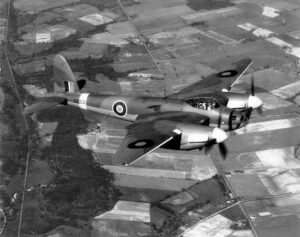
RCAF Mosquito KB306 flying over the USA, later to become F-8 43-34932. Note the flame dampers covering the engine exhaust stubs. Presumably, these were removed when the aircraft gained F-8 status. (Photo from the NARA collection)
The F-8
Mosquito in AAF Service
Aviation literature has scant information on the De Havilland of Canada F-8 Mosquito history. The United States Army Air Forces (AAF) selected this aircraft as an interim solution to solve a long-standing problem during World War II. The following is an edited version from an unpublished copyright manuscript on AAF Mosquito, providing background information regarding its selection and problems encountered bringing the F-8 into operational service. The accidents and incidents detailed in the article are not all-inclusive and more are yet to be
uncovered.
Shortly after the Japanese attacked Pearl Harbor on December 7, 1941, an RAF official visited Washington to explore Army Air Corps (AAC) Intelligence requirements. It was agreed the British Air Ministry (AM) would supply the USA with intelligence concerning Axis forces and targets. The RAF, already with two years of war experience, served as mentor and role model for Army Air Force photo reconnaissance, assisting in all aspects of photo intelligence
development.
Prior to December 7, the Americans confronted an ambiguity when various departments within the AAF had different photo requirements that one aircraft could not achieve. Charting required high-altitude photography for constant-scale, navigation chart production. Mapping required low- and medium-altitude prints to create detailed maps for tactical and strategic use by both ground and air forces. And photo reconnaissance (PR) provided low- and medium-level photos fort actical use, while medium- and high-level photography aided strategic
targeting.
Not only was the AAF lacking in tactical and strategic intelligence areas, they had no aircraft specifically designed to collect this information. Air Transport Command (ATC) diverted four B-24s to photography work for charting but not mapping as requested by the Corps of Engineers. In June 1942, four B-17s were modified for mapping in the European Theater of Operations (ETO) but proved unsuitable for tactical use. In late 1942 a number of B-25s underwent modification for mapping, but again were not considered prudent operationally in combat areas. In war-torn regions conventional aircraft such as the P-39 and P-40 were converted into camera ships on an ad hoc basis for short-range, close-support role. Finally in 1942
. . . .
This article costs $5.00 to download - or it's free for AAHS members.
Already a member? Sign in to download for free.