
The Boeing KC-135 Stratotanker at 50
Alwyn T. Lloyd
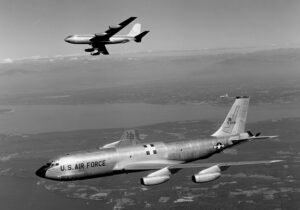
Here, the Model 367-80, fitted with the refueling pod, peels away from first KC-135A, 55-3118. The latter was named "City of Renton" and served in the test fleet until being converted into an EC-135K and transferred to TAC where she served as a command and control airplane. (Boeing)
The Boeing KC-135
Stratotanker at 50
Fifty years ago, on August 31, 1956, the first KC-135A
Stratotanker took off from Renton Airport near Seattle, Washington. This was the first aircraft specifically designed to fulfill the aerial refueling role. Few military aircraft production programs undertaken since the end of WWII can compare with the KC-135 in size, speed of execution, cost effectiveness, and operational
success.
PROGENITORS
Aerial refueling has become a major national asset over the past 60 years. Yes, there were fledgling attempts at transferring fuel in flight during the 1930s. General Curtis E. LeMay was a major proponent of air refueling and assigned some of his most dedicated generals to be advocates for the program. While Tactical Air Command (TAC) and the Navy and Marines preferred a probe and drogue method of refueling, LeMay wanted the boom to provide the high off-load capability that was so necessary for the successful operation of his large
aircraft.
The most successful early program was the hose system that was real Rube Goldberg. Designed by the British company Flight Refueling, Limited, the system called for the receiver to fly high and the tanker to fly low in formation. This system was retrofitted on 92
Superfortresses that were redesignated KB-29Ms, while the receivers became B-29MRs. Both aircraft would reel out a cable, one with a steel ball at the end, and the other with a grapnel hook. Then the tanker would slide-slip beneath the receiver and the two cables would cross. The grapnel moved along the other cable until it engaged the ball. Now the fun began. The receiver would begin reeling in the cables, and the tanker would climb above the receiver. The cable from the tanker had a refueling fitting attached to a hose that was drawn out of the tanker and hauled into the receiver. Now one of the scanners aboard the receiver would attach the hose fitting to a boss in the aircraft’s air refueling system plumbing. Fuel was transferred, the hose was released, and reeled back into the tanker. During the early days, the landscape in the western United States was strewn with various pieces of aerial plumbing. In addition, many a scanner had his brogans filled with 135/150 aviation gasoline as the hose sprayed the waist of the receiver. A better method was
needed.
Next came the Boeing-designed flying boom system that was retrofitted on 116
Superfortress that were redesignated KB-29Ps. The telescoping boom was attached to a hinge fitting on the aft portion of the fuselage and the boom was plumbed into the KB-29Ps refueling system. The boom had a pair
. . . .
This article costs $5.00 to download - or it's free for AAHS members.
Already a member? Sign in to download for free.