
Birth of the Douglas A3D
Bruce Cunningham
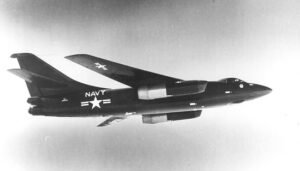
Douglas XA3D-1, BuNo 12412, during flight testing at Edwards AFB. (Douglas photo from the author’s collection)
In 1947 the Navy laid out the specification for a twin-engine, atom-bomb carrying, attack bomber which was to operate from the new Forrestal Class "Super Carrier"Â for which the contract had already been signed. Ed Heinemann had already begun his plans for an airplane to fit this specification. Initial Navy estimates ranged from 62,000 pounds up to 200,000 pounds. Obviously no one in the Navy had a real idea of just exactly how big, how heavy, or how powerful this new bomber should be and it was left to the experts in the aircraft industry to design a product to fit the
specifications.
Further detail studies by the Navy of mission requirements versus carrier capability trimmed the airplane weight requirements to 130,000 pounds and eventually to 100,000 pounds that was felt by the Navy to be the absolute minimum. This weight obviously limited operations of the proposed airplane to the "Super Carrier"Â for which funds had been appropriated on July 29, 1948. The Navy felt that the new "Super Carrier"Â would operate 24 of these 100,000 pound bombers, which were to be powered by four engines, be capable of speeds between 450 and 520 mph and have the capability of delivering an atomic bomb to a target 2,000 miles away and return to land aboard the
carrier.
Ed Heinemann conducted his own investigation and came to the conclusion that, with the political undercurrent in Washington, the "Super Carrier"Â would be canceled, requiring the present Essex Class carriers to continue as the largest in the Navy. He also concluded that 68,000 pounds was the maximum weight of any airplane that the Essex Class carrier could accept. Even then, certain areas of the decks would have to be strengthened to accept arrested landings by aircraft of this weight. As a result, in March 1948, Heinemann made a trip to Washington where he presented drawings of an 80,000 pound turboprop and a 70,000 pound turbojet to the Bureau of Aeronautics
(BuAer).
On August 16, 1948, BuAer sent out an invitation for bids for a 100,000 pound aircraft to 14 aircraft companies. As late as September 13 Heinemann was sent information on BuAer studies 65A and 65B, both of which involved turboprop-powered aircraft, indicating that the Navy did not believe that a turbojet-powered aircraft could perform to the Navy’s requirements. Regardless, Heinemann was still convinced that he could produce a jet-powered attack bomber that would meet the Navy’s requirements and stay within the 68,000 pound weight limitations of current carriers. By November 19, 1948, he had submitted three proposals for a twin-jet attack bomber. These were Douglas Models 593, 593-1 and 593-2, all of which were reviewed and returned for refinement. Designs for Models 593-3, 593-4, 593-5 and 593-6 were developed and, for
. . . . .
This article costs $5.00 to download - or it's free for AAHS members.
Already a member? Sign in to download for free.