
Max Holtzem: An “Old Eagle’ of the First World War. Part Two: Fighter Pilot
Walter A. Musciano and Nick Hauprich
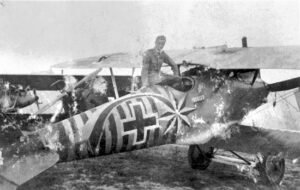
Max Holtzem was called "the Bavarian Comet" by his friends at Jasta 16b by virtue of his unusual flying ability and his personal insignia of a comet. (Photo from Max Holtzem collection)
Max
Holtzem: An "Old Eagle" of the
First World War.
Part Two: Fighter Pilot
When Holtzem
joined Jasta 16b as a fighter pilot late in 1917 he was assigned a Pfalz
D.IIIa which design he had flight tested at the factory one year earlier.
The D.III was the first biplane fighter design produced by Pfalz, the
company having previously built the Roland D.I and D.II aircraft under a
license agreement.
The 160 hp Mercedes six cylinder engine drove the
D.III to a top speed of 103 miles per hour and it required seventeen
minutes to reach 10,000 feet. Despite this inferior speed and rate of
climb the design performed yeoman service at the front because of its ease
of handling and phenomenal strength. The pilots who flew the D.III had no
fear of losing wings or fabric unlike their Albatros and Fokker Triplane
flying comrades. The design had excellent dive recovery characteristics
and was ideally suited for balloon busting. The loaded weight was 2,056
pounds. Two Maxim machine guns were buried in the cowl.
The D.IIIa differed from the original D.III in
that it had a 180-hp Mercedes engine and an enlarged stabilizer, plus
externally mounted machine guns for greater accessibility and cooling.
These craft were often mixed with Albatros scouts in the same unit as was
the case with Jasta 16b.
A few days after his arrival at Jasta 16b
Vizefeldwebel (Vfw.) (master sergeant) Holtzem was ordered by the C.O.,
Leutnant Geigl, to take a familiarization flight over the front lines. The
weather was clear and yet there was very little activity in the air on
that day so Holtzem enjoyed himself at the controls of his Pfalz. As he
turned for La Folie Ferme, the Jasta 16b airfield, Max spotted a lone SPAD
in the distance flying directly toward the Pfalz; head on. The German
immediately prepared for combat as the French fighter loomed in his gun
sight. By this time it was quite evident that the Allied pilot did not see
the Pfalz which was slightly below him. Holtzem was ready to press the
firing button but hesitated a moment . . . . . . . .
This article costs $5.00 to download - or it's free for AAHS members.
Already a member? Sign in to download for free.